Showing posts with label Food. Show all posts

Monday, March 11, 2013

Scone recipe - as requested


One of my readers requested a scone recipe that I talked about in a previous post. So here are a few to choose from:

For previous post see here:

http://forestwoodfolkart.wordpress.com/2012/08/10/the-perfect-scone-at-last/Morning tea - a tradition
Butterless Scones


2 and 1/4 cups Self Raising Flour

1 teaspoon baking powder

1 teaspoon salt

3/4 cup full cream milk

3/4 cup cream

Cut dough with a knife

Roll out to 1″ high, no less cut out individual rounds, and brush top with a little milk.

Bake in Hot oven 210 degrees celsius for 15 minutes

That is it… simple and effective.
Easy Scones

2 cups Self Raising flour or (2 cups plain flour and 2 tsp of baking powder)

1/2 teaspoon salt

1 ounce butter

1 cup Evaporated milk

Sift flour and rub in salt and butter. Add milk.

Pat out to 1/2 inch thickness and cut into shape. Brush top with milke an d

Bake in Hot oven 210 degrees celsius for 10- 12 minutes
PUMPKIN SCONES

1 cup mashed cooked pumpkin

1 tablespoon butter

2 sugar

1 egg

pinch of salt

2 cups Self raising flour

Beat together the pumpking butter and sugar, Add the egg, salt and flour.

Then add enough milk, if needed to make a soft scone dough consistency.

Roll out and cut into rounds or keep as a whole loaf, marking it with a triangle cut on top to allow rising and the middle to cook through.

Brush with milk.

Bake in a hot oven 240 degrees celsius for 10 minutes if scone size (longer for the whole loaf – about 20 – 25 minutes)

Delicious.

I will ponder about the results from these recipes. Please share comments and or photos, if you so wish.

Friday, November 23, 2012

Pumpkin Super vitamin A source

Made up of 85% carbs, 8 % protein 3% fat pumpkin is a forgotten about vegetable that kids will continually  turn their nose up at. But did you know that it keeps for up to 6 months, when whole and is really quite good for you. Not only is pumpkin loaded with a whopping  245 % of  the average person’s daily needs of Vitamin A, as well as antioxidant carotenoids, like alpha and beta-carotenes, it’s a fantastic source of vitamins C, (19% of daily needs) K, and E. Furthermore, it has lots of minerals, including magnesium, potassium, and iron, riboflavin and fibre.
This is the perfect time of year to be eating a little more pumpkin.
To read more nutritional information here:
http://nutritiondata.self.com/facts/vegetables-and-vegetable-products/2601/2

Pumpkin seeds (Pepitas)
Pumpkin seeds, called pepitas, are loaded with minerals, and seem to have an anti-inflammatory effect. Claims have been made that they also help protect against prostate cancer and osteoporosis. A quarter cup has about 1.5 grams of fibre.
Selection
Choose a pumpkin that feels heavy for its size and tap on it with your knuckles. It should sound woody. Stay away from the larger pumpkin, smaller and denser is better, in this case.
Storage
Pumpkins can keep for up to six months  in a cool, dry place. It may even help to put newspapers underneath to absorb any dampness. Once the pumpkin is cut it will only keep for a few days, but may keep for longer if you remove the seeds and stringy centre and leave open. ie: Do not wrap in glad wrap. Cooked, it’s fine in the refrigerator for 4 to 5 days.
Basic Easy Cooking Techniques  from http://lowcarbdiets.about.com/od/whattoeat/a/pumpkin.htm:

For pumpkin puree: Remember, you heard it here first: You don’t need to cut the pumpkin open before you roast it. I’m not kidding. Just jab it with a knife once or twice to vent the steam, put the whole darned thing on a baking sheet, and pop it in the oven at 350 F for an hour or so, until you can easily stick a knife into it. (Once I had to leave in the middle of this, so I turned off the oven after 20 minutes, and when I came back several hours later it was perfectly cooked.) Cool, then scoop out the seeds and stringy stuff with a spoon, or pull it out with tongs. It is SO MUCH EASIER than when it is raw.
If you want chunks, you’ll have to cut into it raw (though I have wondered if “par-roasting” would work to make the skin easier to hack into). Or find a store where you can buy it already in chunks. Or beg the produce guy at your local market to do it. Explain that people (such as you) would gladly pay more if someone else had done the wrestling.
For the seeds, let them dry on paper towels, then oil and salt them (and any other seasonings you want) and slow roast them in a 250 F oven until they smell good – about 45 to 60 minutes. Stir them every 15 minutes or so.
 
Pumpkin plants The plant is a fast-growing vine, in my yard, self sows from the compost bin, creeping along the ground surface. It is one of the most popular field crops cultivated around the world, including the USA at the commercial-scale for its fruit, and seeds.
Pumpkins are readily available in the market year around. Buy well-grown whole pumpkin instead of sections. Look for mature product that features fine woody note on tapping, heavy in hand and dry, stout stem. Avoid the one with wrinkled surface, cuts and bruises.
Once at home, fully ripen pumpkin can be stored for many weeks at cool, well-ventilated place at room temperature. However, cut sections should be placed inside the refrigerator where it can keep well for a few days.
Ways to Eat Pumpkin
Pumpkin can be used in any squash recipe, but it has a depth of flavor that many other winter squashes don’t. Of course, we have to have pumpkin pie, and my low-carb pumpkin pie never fails to get raves.
Other than using it in the Roast Vegetable frittata and pie, you can use it in sweet recipes.
My favourites include: Pumpkin Scones and if you are in USA: Pumpkin Choc-chip muffins (pictured above)

PUMPKIN SCONES
Ingredients:
I cup of mashed pumpkin
1 tablespoon butter
2 tablespoon sugar
Beat these together, then add:
1 egg
pinch of salt
2 cups self-raising flour
Add enough milk, if needed to make a scone dough.
Roll out to 3/4 ” or 3 cm thick
Brush tops of scones with milk.
Bake in Hot Oven 250 degrees for 10 minutes

That is it. Hope you all ponder over this ....

Thursday, November 15, 2012

Is Christmas too Commercialized? Low cost gifts and Activities

Decorations are in the shops from August in some places, carols are playing over the speakers in shopping centres, and xmas comes earlier and becomes more commercialised every year.

Even kids are organized early these days. This appeared on my bedroom wall, posted by my daughter, several weeks ago. Just in case I was unsure of what exactly to buy for her for Xmas.  There is such expectations around gift giving now. Mind you, can't really blame the kid for trying, even if the follow through does not reach such dizzying heights.
Humbling was the child from one family, who when asked what they got from Santa, was overheard to say, ," ...A new lunchbox for school"  and did this pull at my heart strings?  Oh yes, indeed. Makes me think of some possible options for non material gifts, and low cost or free activities, that one can request and give for Christmas such as the ideas outlined below:
( These could be written on pretty gift cards, placed in a "surprize bag" and pulled out by each child/ adult as a kind of lucky dip)
* A warm and cosy evening/day spent doing whatever each child wishes, one on one, without disturbances from computer, phone, mobile phone or Ipod, Ipad etc etc.  It might be a board game, cocoa and a chat, playing games, like hide n seek, or pictionary/ monopoly.
* A walk or play on the beach, perhaps with the promise of ice cream afterwards.
* Rainforest hike
* If the kids are into books, a trip to the library.
* Building a cubby house, go cart, or raft together. This can be as complex or as simple as you like: the full wooden hammer and nails bit, or a large cardboard box.
* Sewing or embroidering a calico bag
* Making a card or memory album for Grandma
* Comstructing a year in my family chronicle to give out to family members at Xmas with recipes, funny stories, and photos.
* Making the Christmas cake/ lolly or cookie jars to give to others.
* Setting out tea light candles on your street and letterbox dropping others to do the same. We do this and call it 'Santa's highway'.
* A puppet show and stage presentation to family members
* A talent quest for family members with a Christmas theme (Prizes for everyone)
* Swimming or running races
* Trampoline competitions
* A Christmas themed movie or powerpoint presentation for Grandparents and/or extended family
There are plenty more ideas available on the net or in books, so these are just a few that came to me, off the top of my head. Believe me, this kind of experience stays in a child's memory for much longer than the short lived joy of getting a toy that will be forgotten in a few months time.
http://www.ehow.com/list_6383128_cheap-holiday-gift-ideas-kids.html
http://voices.yahoo.com/ideas-cheap-christmas-gifts-kids-4754448.html
Feel free to add your own. Christmas need not be super expensive. Be creative and have fun, and still be giving a priceless gift that has the bonus of being environmentally friendly.
These activities will surely be Something kids will ponder about when they themselves, become parents.

Sunday, October 28, 2012

Orange Cake Recipe - Afternoon tea Cake

10 minute Processor Orange Cake

Reminescing about my Danish Grandmother who always used to cook a fresh Orange cake for Sunday afternoon tea, I remembered how, as children,
my brother and I looked forward to visiting her house as the aroma of fresh home bake would come wafting out the door, when we arrived.
It is important to anyone can abandon convenience food a.k.a. supermarket style prepared cakes, in favour of a mouth-watering freshly baked treat for afternoon tea,  and know that it is not difficult nor time consuming. I think this cake took me less than 10 minutes to cook, due to speedy preparation in the processor. Then you simply wait for the oven timer to ring, and voila!
Just perfect for a lazy Sunday afternoon tea, this quick and easy recipe will have your family's mouth watering for more. Apart from the sugar content, and a small amount of necessary butter,there are no extra unhealthy ingredients; plus it has the advantage of a bit of Vitamin C and delightful orange flavour.
A cake that is good for you! Yay!
No need to add any frosting or topping, just eat it warm out of the oven.
Of course, if you wish a dusting of vanilla/icing sugar, or a cream cheese frosting would be a nice option,if you aren't counting calories.
Ingredients:
1 cup Castor or fine grain sugar
1 Cup Self Raising flour ( or 1 cup plain flour and 2 tsp baking powder)
2 tablespoon extra of plain flour
2 tsp grated orange rind
1/2 cup orange juice
60 g soft butter
2 eggs
Method:
1. Combine sugar, flours, and orange rind in processor with butter. Process till just combined.
2. Pour Orange juice through the chute with motor on.
3. Add eggs and blitz till smooth.
4. Pour into well greased bar tin ( base 12 x 22cm or 5 x 9inch) that has base lined with greaseproof paper.
5. Bake Moderate Oven 40 minutes or till top springs back when lightly pressed.
Cool 5 minutes in tin before turning out on wire rack to cool.
Map
Visit Book Blogs

Sunday, October 21, 2012

Five Minute Appetizing Salad

I just love the colours and tastes in this simple salad. It is so tempting to the tastebuds due to the mix of colours, textures and flavours. How can anyone refuse?Using some of my home grown vegetables referred to in the previous post.
Click here  http://wp.me/p1KAF8-kI   you could make it in just under 5 minutes.
Organic Cos Lettuce, torn roughly.
Red Oakleaf Lettuce
Capsicum ( Red )
Lebanese cucumber
Tomato, quartered
Spanish Olives
Marinated feta cubes ( or use fresh feta with accompanying herbs and olive oil)
Alfalfa sprouts to garnish
Optional extra:
Blanched asparagus
Chop fresh asparagus into 2 inch pieces and plunge into boiling water for 2-3 minutes. Refresh in chilled or cold water til cool, and then add to salad.
If you are counting calories, forget the dressing! Anyhow, the marinated feta gives it enough flavour!
A simple appetizing salad that looks impressive, but is so simple, it is a piece of cake!!! Salad like cake  is something to ponder about!

Monday, September 10, 2012

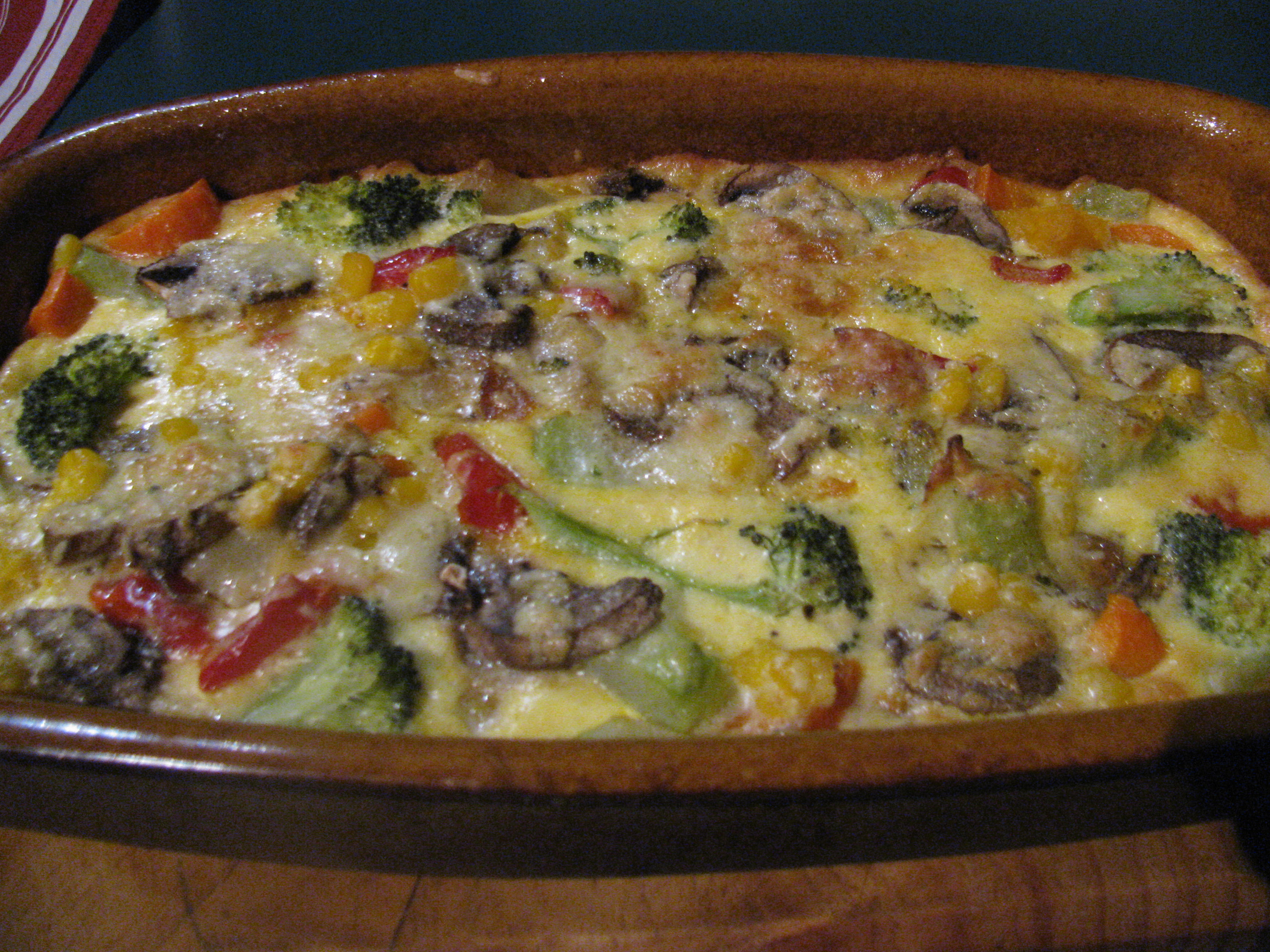
Quick Meals from Leftovers: Roast Vegetable Frittata and Chicken Vol au Vents


Map
How do you turn some unwanted leftovers into a delicious meal and save yourself time, energy and food.Turn out a scrumptious meal in a little over half an hour.

Roast Vegetable Frittata

Pre Heat Oven to 190 degrees Celsius or 375 degrees Fahrenheit
What you need:
A quantity of Roast vegetables
I use Sweet potato or kumara, onion, potato, pumpkin, zucchini, choko, red capsicum, carrot or just about anything. (It is great to have a variety of green, orange white and red if you can.) I usually make up a large batch and if they are all eaten, fine. And if not: I have a delicious meal almost ready to eat the following night.
[Optional extras: Broccoli florets, mushrooms and 1 small can of corn kernels]
1/2  - 3/4 cup cream
2 eggs
1/4 cup  milk
Seasoning
1 cup of tasty cheese
1. Chop leftover veges roughly into 1 inch cubes and arrange in ovenproof dish so that they are evenly dispersed. Nothing worse than having all carrot in one portion and all choko in another! You can also add some broccoli, mushroom and a little tin of corn kernels as optional extras.
2. Combine the remaining ingredients and pour over the veges.
3. Top with a your choice of tasty or flavoured cheese. I used basil and pesto Mersey valley cheese. ( you will probably only find this brand in Australia)
4. Cook in moderate oven for a little over 20 minutes till cooked.
If you also have leftover chicken, then you can make a complete meal as follows while the Frittata is cooking:

Chicken Vol au Vents ( using leftover cooked chicken)


Pre Heat Oven to 190 degrees Celsius or 375 degrees Fahrenheit
Ingredients:
3 sliced mushrooms
1 diced onion
Quantity of shredded cooked chicken (leftovers) Approximately 1 - 2 cups
4 Vol au Vent pastries ( round pastry cases that have been pre cooked - readily available in supermarket)
Parsley or herbs as desired.
Method:
1. Saute onion in a little olive oil on medium heat in  a frying pan til transparent.
2. Add  sliced mushrooms and shredded chicken (leftover)
3. Place Vol au Vent pastries in moderate oven to warm
4. Add 1 cup of sour cream, and 1/2 cup milk to pan and stir through, slowly increasing the heat til sauce is thickened.
5. Place mix in warmed Vol au Vent cases and serve with portions of the above frittata.
A complete and easily prepared meal supplying Protein, fibre, vitamins and delcious taste, all under 45 minutes. We all eat and most of us work, so quick well balanced meals are something we need to ponder about.

Tuesday, August 21, 2012

GRAVAD LAX, GRAVLAX, SMOKED SALMON - DIY

It is so easy to make your own smoked salmon. I have just found out how and will follow its progress via this blog:
1. Buy fresh piece of Salmon with skin on and cut into two equal size pieces.
Day 1 - oops forgot the black pepper!!
2. Remove any bones with tweezers
3. Cover pink side of salmon  with a combined mix of  1/2 cup salt and 1 cup sugar and some ground black pepper.
4.Chop up 2 bunches of fresh dil, stalks and leaves.
5. Layer the salmon, skin side on, then cover liberally with the chopped dill.
6. Finally add the second salmon piece so that the skin side is upwards
7. Cover with cling film, and leave at room temperature for 6 hours.
8. Place in fridge for 2-7 days - 5 days is suggested time for my recipe, turning every 12 hours.
9. Drain juices, scrape off dill and pat dry with paper towel. Then slice wafer thin and enjoy!


Map

Visit Book Blogs

Monday, June 25, 2012

White / Brown Rice: What is the Difference? Recipes


Nutty brown rice Rice - its nutrition and place as a staple is unquestionable. Whole civilisations exist on it, or variations of it - even today in our modern societies.
Dr Lam at  http://www.drlam.com/opinion/brown_rice_vs_white_rice.asp
tells us that white rice, is comprised of mostly carbohydrates, with the nutrients stripped off in the milling process, which removes the outer husk (where all the nutriets are contained) from the brown rice and thus is becomes "white" rice.
Carbohydrates are broken down into sugar inside the body. While carbohydrates are a good source of energy (yielding 4 calories per gram), excessive carbohydrate intake leads to sugar imbalance. Carbohydrates are also addictive, and lead to cravings. Thus brown rice is a way to break the addictive 'sugar' cycle.
Wiki also sheds some light on the difference telling us that whilst both types of rice have similar calories and carbohydrates, the main differences between the two forms  lie in processing and nutritional content.
When only the outermost layer of a grain of rice (the husk) is removed, brown rice is produced. To produce white rice, the next layers underneath the husk (the bran layer and the germ) are removed, leaving mostly the starchy endosperm. Several vitamins and dietary minerals are lost in this process. Fatty Acids, fibre, rice bran oil ( which can lower LDL cholesterol), are removed in the milling and Vitamin B1, vitamin B3, and iron are sometimes needed to be added back into the white rice making it "enriched".
One mineral not added back into white rice is magnesium; one cup (195 g) of cooked long grain brown rice contains 84 mg of magnesium while one cup of white rice contains 19 mg.
So, having established that Brown rice is better for us, can we make it a little better ? I have used this recipe on my family which has an intense dislike for brown rice, and so far I have three converts, well, 2 at least, one is sitting on the fence atm!!! So here is the recipes I use at home, which can be adapted or used as is, for a variety of dishes including Chinese fried rice, Rice Pilaf, vegetarian dishes and many more.

Nutty rice in the pot

NUTTY BROWN RICE

2  tbspn olive oil
1 large onion, finely chopped
50 g ( 2 oz) pine nuts
1/4 cupsful of brown rice
1 1/2- 2 cups of vege or chicken stock or water ) boiling
1/2 tsp thyme
1-2 bay leaves
Method:
1. Heat oil in heavy saucepan and saute pine nuts for 1-2 minutes till golden brown
2. Saute onion till soft. ( celery could also be nice added in here for touch of greenery)
3. Add the rice, stirring well till all the grains are well coated with the oil.
4. Add the stock or water, and bring to the boil.
5. Add thyme and bayleaf and cover.
6. Cook 45- 50 minutes simmering on low - med heat till all liquid is absorbed. *
* I use 2 cups of liquid otherwise if left to simmer dry, it leaves a mess on the base of the saucepan, which required a good scrub to remove.
7. Season if desired - I usually don't as the nutty flavour and stock is enough to bring out the flavour.
Variations:
Add  1/4 tsp cumin towards the end of cooking and raisins/sultanas as desired.
Leftovers can be turned in to a warm/cold summer salad  by adding bean sprouts, celery and / or stir frying left over rice for 5 mins.
This Nutty brown rice is so yummy it will convert even the more drastic of white rice eaters amongst us!!

MICROWAVE QUICK WHITE RICE

For this you need: a microwave-proof bowl, or microwave-proof rice cooker.
1. First wash 1 and 1/2 cups white rice under running water till water is clear.
2. Place in microwave bowl or cooker with 2 cups of WARM water, placing paper towel underneath to absorb any overflow during the cooking process.
3. Cover with lid/plastic wrap
4. I program in the time but you can do it manually if you prefer:*
Microwave high power         - 3 minutes
Microwave medium power  - 7 minutes
Standing Timer / no power - 3 minutes
*Microwaves can vary in power, mine is 1200 watts, but I have successfully used this recipe in 800- 1000 watt microwave ovens too.
When done, fluff with a fork. That is it, enjoy.
This is a great way to prepare rice for Chinese fried rice, as you can easily make it the day before, allowing it to dry out in readiness for being stir-fried.

Which way will you prepare your next rice dish? And which rice will you use? Something rice eaters will more than likely ponder about.

Sunday, June 24, 2012

Quick Beef Stroganoff - with Rice


A busy life with a family means hearty, nutritious meals that can be made in minutes. ( or half and hour: tops)  This is a variation of a Veal Goulash recipe I had that takes much longer to cook and uses stewing veal or beef as opposed to leaner, finer cuts.
Just why is something that I ponder about, but I do notice many young people are lacking this instinctive knack of creating a meal with whatever is in the fridge, so I have posted this recipe or "throw – together," as I prefer to think of it, for their benefit. Established cooks most likely will have this or a variation of this in their repertoire.

INGREDIENTS:
1 onion, 2 stalks celery, a quantity of beef /bbq beef/ beef schnitzel or similar cut, enough to feed the required amount of people, sour cream, tomato paste, handful- 1 cup of chopped mushrooms, 1 cup chicken or beef stock ( or 1 cup water and 1 chicken/beef stock cube)

Method:
1. Cut beef along the grain and cook on moderate to high heat, quickly, almost till done. Remove and keep warm.
saute onion and celery
2.  Saute some finely chopped onion and celery in a dash of olive oil till onion is transparent.
3. Add mushrooms,  and cook briefly, for several minutes.
4.  Add 3 tbspns of tomato paste ( or whatever quantity the sachet comes in) and 1 cup Chicken or beef stock and cook for about 5 minutes or till sauce has thickened.
5.  Return cooked beef to pan and stir through 1/2 cup sour cream. ( Substitutes for sour cream could be whipping/pouring cream, evaporated milk, full cream milk ( sauce may be more runny)
6. Serve with nutty /white rice ( see recipe on next post)
Recipes for preparing Brown and White rice: Just what is the difference?

This dish is also nice with crusty baguettes/ breads.

Enjoy!

Wednesday, June 13, 2012

Creating The Perfect Cookie/Biscuit

Do you feel frustrated when your home-baked cookies/biscuits are too hard, too soft, way-too-spread-out, or hard enough to use as a baseball in the back yard? 

My investigations below were sourced from 2 websites (which I have linked) and lead me to conclude that baking is a kind of science, and pastrycooks and chefs who are required to replicate the exact same foods with the exact same textures and tastes have my endless admiration. For the path to creating the perfect biscuit is laden with pitfalls, and endless variables that are bound to confuse, frustrate and annoy the most patient and placid of us.
Not only do you have to achieve consistency at technique, control the uncontrollable variations in oven temperature and heat distribution, you also have to conquer such variables as appropriate shelf height and heat setting in multifunctional ovens, incorrect weighing/measuring of ingredients, the endless debate on whether to fold or beat, cover or uncover the cooked item, and the list goes on.
Something as simple as using low fat butter or milk can drastically alter results.  Nevertheless, it is useful to consider why things may have gone wrong.....
From
www.sunset.com › Food and Wine › Techniques:


What makes cookies soft and chewy?
High moisture content does; so the recipe, baking time, and temperature must be adjusted to retain moisture. Binding the water in butter, eggs, and brown sugar (it contains molasses, which is 10 percent water) with flour slows its evaporation. The dough needs a little extra flour, which makes it stiffer. The stiff dough spreads less, less liquid evaporates, and the cookies are thicker.
Mass also helps cookies stay moist--big dollops of dough make softer and chewier cookies than tiny spoonfuls of dough. Bake these thick cookies for a shorter time at a high temperature to firm them quickly and minimize spreading. Most important, don't bake them too long--remove from the oven when the cookie rim is brown and at least 1/3 of the center top remains pale. The cooked centers will be soft.
Why are some cookies cakelike instead of chewy?
A little extra liquid in the cookie dough from water, egg, or milk makes the dough more elastic and adds steam as the cookies bake, making them puff more.

What makes a cookie crisp or crunchy?
Reducing the amount of ingredients that hold moisture--flour, egg, and brown sugar--makes it easy for liquid to evaporate, producing crisp cookies. The fat, which goes up proportionately when other ingredients are cut back, gets hotter than the water in the dough and drives out the moisture. Fat also makes the dough softer and melts when hot, making the cookies spread. For crispness, bake cookies longer at a lower temperature to give them more time to spread before they firm. Then bake long enough to dry and brown them evenly to develop the maximum toasty flavor and crisp texture throughout.
What else makes cookies spread as they bake?
We've had many calls and letters from cooks having trouble with favorite recipes. All of a sudden, their cookies are spreading excessively. Most often the culprit is low-fat butter or margarine spread, which has about 20 percent more water, used in place of regular butter or margarine. It's this extra liquid that's causing the problem. Low-fat products can't be used interchangeably with regular fats for baking without recipe adjustments.
Cookies also spread when you drop high-fat dough onto a hot baking sheet; the heat melts the dough, and cookies spread before they're baked enough to hold their shape.
"When others follow my recipe for chocolate chip cookies, they turn out crunchy. Mine turn out chewy. Why?" asks Bobbie Barrett of San Carlos, California.
The way they measure ingredients and the real temperature of their ovens are the usual reasons cooks get different results from the same recipe. Flour should be stirred to loosen and fluff it, then spooned gently into a dry-measure cup (the kind you fill to the rim), and the top scraped level. If you tap the cup or scoop flour from the bag, the flour gets packed down and you can easily add 2 to 4 extra tablespoons flour per cup.
You can scoop up white sugar; it doesn't pack. But you should firmly pack brown sugar into a dry-measure cup and scrape the top level. Dry ingredients should not be measured in heaped-up cups or spoons; scrape dry ingredients level with the surface of the measuring tool. Measure liquid ingredients with liquid-measuring (usually glass or plastic) cups.
If your cookies bake faster or slower than the recipe indicates they should, chances are your oven thermostat isn't registering accurately. It's a good idea to double-check oven temperature with a thermometer and adjust oven setting as needed.

From Whatscookingamerica.net some very useful tips:
http://whatscookingamerica.net/Cookie/CookieTips.htm

Controlling Spread in Cookies with Baking Soda:

From How Baking Works; Exploring the fundamentals of Baking Science, by Paula Figoni
Cookies spread across a cookie sheet when a they have too little structure and cannot hold their shape. Whether this is desirable or not depends on what kind of cookie you wish to bake, but often some spread is desirable.
There are many ways to increase cookie spread: One way is to add a small amount of baking soda, as little as .25 to .5 ounce (5 to 15 grams) for 10 pounds (4.5 kilograms) of cookie dough. This increases pH of the dough, weakening gluten, and also weakening egg protein structure. With less structure, cookies spread more and have a coarser, more porous crumb. Since moisture evaporates from a porous crumb more easily, baking soda often provides for a crisper crumb, as well.
Measure baking soda carefully. Baking soda increases browning significantly, and if used at too high a level, it leaves a distance salty-chemical off flavor. Too much baking soda also causes eggs in baked goods to turn grayish green.
When working a high altitudes, omit baking soda from the cookie dough. The lower air pressure at high altitudes already encourages spread.

 
use date on end of egg carton
Eggs:  Check your date on your egg carton. Eggs should be at room temperature. Also the emulsion can be ruined if eggs or other liquids are too cold or too hot when they are added.
 
Measuring Flour: Too much flour can make some cookies rock-hard. When in doubt, err on the side of less flour. Even better, use a scale if the recipe offers a weight equivalent. Spoon the flour into your measuring cup and sweep a spatula across the top to level it off. Don't use the measuring cup as a scoop or it'll pack the flour and you'll end up with more flour in the cup than intended. See #6 below for additional information.
 
Nuts:  Smell and taste nuts before using. Oils in nuts can turn rancid quickly. Store any leftover nuts in the freezer for longest shelf life.
 
Butter:  Make sure your butter is at room temperature, otherwise it won't cream properly with the sugar. The terms "room temperature," "softened" and "soft" mean different things. The temperature of the butter can make a difference in the recipe. Most cookie dough recipes depend on the emulsion that occurs when you cream butter and sugar together. This emulsion will not happen if the butter is too hot or too cold.

Room Temperature Butter: It should be pliable enough that your finger can leave a mark in it, without being soft and greasy. Set the butter out at least one (1) hour in advance.
Softened Butter: Will feel a little warmer to the touch, and it will be much easier to leave a deep indentation, but it should still be firm enough to pick up without falling apart.
Soft Butter: Will be too soft to pick up.
Microwave Butter: Do not try to microwave your butter as it will just end up too soft. If you don't have an hour's lead time, increase the surface area by cutting the butter into small pieces or shredding it on the large holes of a grater. It will then come up to temperature in approximately 10 minutes.
Unsalted Butter: Unsalted butter is generally recommended because some salted butters have more sodium than others.  Do not use low fat butter/margarine. Low fat margarine has 20 % more water.

Salt:  Use the full amount of salt called for in a recipe, especially is using unsalted butter. If you use salted butter, only use 1/2 the amount called for in the recipe. Don't skip the salt, as salt brings out flavors and balances the sweetness in a recipe.

Sugar: The type of sugar used in your cookies can promote spread in baked cookies. To understand this, you need to know that sugar is a tenderizer which interferes with the formation structure. Sugars with a finger granulation promote more spread (probably because they dissolve sooner and only dissolved sugars will tenderize). Powdered sugar (confectioner's sugar), when it contain cornstarch, prevents spread in cookies despite it finer grind.

Good luck to you all, and I would be pleased to hear any more useful tips any other kitchen scientists care to share with me....I will certainly ponder about this. 

Thursday, May 31, 2012

Mel's Chocolate Slice

Decadent and Simple Chocolate Slice - what more could you want?

This slice is great for desserts, lunch boxes and especially kids parties....easy and so quick. For those cooks, like me that have no success melting chocolate.You can not stuff this one up if you buy the block cooking chocolate (do not use those useless chocolate buttons - they never work)

Mel's Chocolate Slice


Ingredients:
1 cup Brown sugar
125 g unsalted butter
1 cup Plain flour, sifted
2 eggs, whisked
1 Block of dark cooking chocolate
1 teaspoon vanilla essence

Method:
Preheat Oven to 180 degrees celsius. Line a slice tray with baking paper.
Melt butter and chocolate in a saucepan over low to medium heat. When close to melted, add the sugar and vanilla essence and stir until dissolved.
Remove from the heat and quickly stir in the whisked eggs 
(must stir quickly to prevent the eggs from cooking) 
Stir through the sifted flour until all mixed through.
Pour in to lined baking tray and cook for 20-25 minutes.

Might be nice dusted with Icing sugar to serve.
Enjoy!!
Mel...

Something to ponder about whilst eating and savouring the chocolately decadent taste!!


Sunday, May 27, 2012

Decorations, Food and Favours for a Girl's Birthday party

Preparing for 12 year olds to celebrate a birthday involves three main items:


 1. Decorations
- preferably  fancy do-it-yourself (unless you are a millionaire)

2. Youtube 
(or once again if you are wealthy, a Karaoke machine)
I set up a laptop and added extra speakers for volume and internet wi-fi connection to Youtube... cheap as chips!

and...

3. Chocolate
- lots of it and all different varieties

Chocolate slice (recipe to follow) ***see post for 31st May 2012
Tim tams
Fantails
Snowballs
Freckles
Any chocolate covered lollie or biscuit
A Large Block of chocolate for chocolate eating contest and several more for prizes (Instructions to follow)

Party Favours/Bags

You can also make fun party bags/ favours with inexpensive noodle boxes filled with a few lollies decorated with flowers, patty cakes leftover from the party ( if there is any left ), and nail polish, lip gloss, stickers and other fun things for girls.

Chupa Chupa Flowers
Cut a small square of pretty paper about 10-15 cm and fold in half to form a triangle shape. Fold sides in and up to the opposite side, as shown in picture. Draw a petal shape over the centre and cut.  Cut a very tiny section off the point and open up to reveal a flower shape. Insert a chupa chup or lollipop on a stick and voila!!


Patty Cakes Party Cake
With some icing and simple decorations, a patty or cupcake can take on a whole new dimension. Supermarkets sell pre made flowers, and some icing and cachous/sprinkles really jazz it up to look good.


I must ponder about how much money I saved, not what I spent, but nevertheless this is so much better and less expensive than a McDonald's party..... and the Kids will have more fun...

Sunday, May 20, 2012

Syttende mai. Hurra for Norge!!! Happy Birthday Norway

Ja vi elsker dette landet,
Som de stiger frem .... In fact Norway has had three national anthems. The first, written in 1772, by Joahn Nordahl Brun with talk of "blood on the teeth..." Bit scary! But then they are Vikings... Then in 1819, Henrik Hans Bjerregaard wrote Sons of Norway, and finalyy in 1864, Bjørnstjerne Bjørnsson wrote the words in the video which remain the anthem today.....


Not only was the anthem heard, but also "Mellom bakker og berg et med havet" was sung by the Scandinavian singers in the Thyme interactive Restaurant at the Sofitel Luxury hotel in Brisbane today. Why? Because it was a "fest" for Norway's birthday... 198 years old today, (since separation from Denmark) or if you prefer, 107 years since independence from Sweden.... So Gratulerer med dagen Norge. Hurra Hurra Hurra!


The celebration started officialy last thursday, when on syttende mai ( 17th May ) the Norwegian students from QUT university here organized the street march through Brisbane.  This really confuses the people of Brisbane who can't really recognize the flag. I love seeing their facesas all the Norwegians walk along singing at the top of their voices. And street marches are illegal in this state of Queensland, so I like the fact that one can legally stop the traffic in this way.

Thyme interactive Restaurant
And the celebrations really got up and going with the "Constitition Day" buffet at the Thyme restaurant at the Sofitel Luxury Hotel. The roll up each year just gets bigger and bigger!! Over 80 diners this year combined to eat, feast, sing and celebrate. Me included.

Chili Crab
King Prawns!!!
And the seafood on offer would make a Viking proud..... Chilli crab, Prawns the size of a large man's fist (scandinavians take note!) Whole baked snapper, Mussels, Oysters, Salmon, Scottish peppered mackerel, as well as several roasts, pappadums, curry, salads, veges and I won't begin to discuss the desserts. I will let the pictures tell the story...
Desserts to die for....

Now I am several kilos heavier, and that is something I don't want to ponder about for too long.... What I will ponder about is that England stuck its nose into Scandinavian affairs making Norway war spoils in return for Sweden backing England against Napoleon. In fact, forcing Norway to accept Swedish control or else they would blockade all imports to Norway in 1814. What bastardry was this? Forcing people to starve so that they could win economic and political advantage in the region? Abhorrent. And dare I say, typical of England self important ego.

So this is how Norway had to wait almost another 100 years until they gained full independence as a country.  Not a good day for Napoleon, Denmark or Norway. I guess a good day for Sweden!!


Wednesday, March 28, 2012

Fermented and sour milk products in Australia

The Confusing array of Fermented Milk products:
Fil milk
Quark
Kefit


Can one find dairy products other than milk and yoghurts in Australia?  A big ask I think as these products can be confined to certain areas of the world, like Scandinavia, where they have been traditionally eaten.
For example: A -fil is commonly found in parts of Sweden and Norway. It is a little like a yoghurt drink, but less tarty and sour. It is beautiful on Muesli, and cereals, and as a dessert with berries. In Scandinavia, you can even get flavoured varieties, particularly berry flavoured a-Fil. 

Not only is this soured milk extremely good for you, because of its calcium content, it is also good for one's digestion, due to the beneficial bacteria it contains.Whilst trying to determine whether these products were available here, I was able to ascertain some interesting information coalesced in the following blog entry.


A food forum claims that if a recipe calls for sour milk, the translation of 'Fil' one could use buttermilk ( which although thought to be particularly fatty, is not). Alternatively, one can sour 3/4 cup ordinary milk with 1 tsp of apple vinegar or white vinegar, or lemon juice. Let stand for 5 minutes the writer claims.

 Wiki provides us with a different explanation:
Filmjölk (also known as fil or the older word surmjölk) is a Nordic dairy product, similar to yoghurt, but using different bacteria which give a different taste and texture.
It can also be described as a mesophilic fermented milk product that is made by fermenting cow's milk with a variety of bacteria from the species Lactococcus lactis and Leuconostoc mesenteroides.[2][3] The bacteria metabolize lactose, the sugar naturally found in milk, into lactic acid which means people who are lactose intolerant can consume filmjölk. The acid gives filmjölk a sour taste and causes proteins in the milk, mainly casein, to coagulate, thus thickening the final product. The bacteria also produce a limited amount of diacetyl, which gives filmjölk its characteristic taste.[4] Filmjölk is similar to cultured buttermilk, kefir, or yoghurt in consistency, but fermented by different bacteria and thus has a slightly different taste. Compared with yoghurt, filmjölk tastes less sour. In Sweden, it is normally sold in 1-liter packages with live bacteria.

In Nordic countries, filmjölk is commonly eaten during breakfast or as a snack between meals in the same manner as yoghurt, usually from a bowl with a spoon. It can be drunk but is not normally done so since the liquid is fairly thick. Filmjölk is often eaten with breakfast cereal, muesli or crushed crisp bread on top. Since plain filmjölk tastes somewhat sour, many people add sugar, jam, apple sauce, cinnamon, ginger, fruits, and/or berries. In Norwegian it is called surmelk (new Norwegian: surmjølk) (sourmilk) but the official name is kulturmelk (new Norwegian: kulturmjølk).

Manufactured filmjölk is made from pasteurised, homogenised, and standardised cow's milk. Although home made filmjölk has been around for a long time (written records from the 18th century speak of filmjölk-like products, but it has probably been around since the Viking Age or longer),[5] it was first introduced to the Swedish market as a consumer product in 1931 by the Swedish dairy cooperative Arla, who have a large factory in below pictured Danish town of Christiansfeld. From here, they freight these milk products far and wide, even to America.


IN 1984, Arla produced A-Fil, (the product in question), a Filmjölk with Lactobacillus acidophilus, a commonly used probiotic bacteria. Comes unflavoured and flavoured. Strawberry appears to be the most popular flavour.

To make filmjölk, a small amount of bacteria from an active batch of filmjölk is normally transferred to pasteurised milk and then left one to two days to ferment at room temperature or in a cool cellar. The fil culture is needed when using pasteurised milk because the bacteria occurring naturally in milk are killed during the pasteurization process.
A variant of filmjölk called tätmjölk, filtäte, täte or långmjölk is made by rubbing the inside of a container with leaves of certain plants: sundew (Drosera, Swedish: sileshår)[65] or butterwort (Pinguicula, Swedish: tätört).[66][67][68] Lukewarm milk is added to the container and left to ferment for one to two days. More tätmjölk can then be made by adding completed tätmjölk to milk. In Flora Lapponica (1737), Carl von Linné described a recipe for tätmjölk and wrote that any species of butterwort could be used to make tätmjölk.[66]Sundew and butterwort are carnivorous plants that have enzymes that degrade proteins,[69] which make the milk thick. How butterwort influences the production of tätmjölk is not completely understood


Then there is Quark, which is rather like Cottage or Ricotta cheese but made from Soured milk. To clear up the distinctions between all these interesting dairy products, I called on Wikipedia and the source product and location appear to be fundamental in the end product produced! Does this mean that sour milk would not be sour milk if made in Australia? 


Wikipedia states that Quark is:

Quark is a type of fresh cheese, also known as tvorog (from the Russian творог), topfen (from the Austrian name), biezpiens (from Latvian), and varškė (from Lithuanian). It is made by warming soured milk until the desired degree of denaturation of milk proteins is met, and then strained. Dictionaries usually translate it as curd cheese or cottage cheese, although most commercial varieties of cottage cheese are made with rennet, whereas traditional quark is not. It is soft, white and unaged, similar to some types of fromage frais. It is distinct from ricotta because ricotta (Italian: recooked) is made from scalded whey. Quark usually has much lower fat content (about the same as yoghurt) than cream cheeses and has no salt added.

Quark is a member of the acid set cheese group, meaning it is traditionally made without the aid of rennet.[2] In most German dairies today, it is made with rennet.[3] Lactic acid bacteria are added in the form of mesophilic Lactococcus starter cultures. In Germany, the curd is continuously stirred to prevent it from getting hard, resulting in a thick, creamy texture. It has the firmness of sour cream but is slightly drier, resulting in a somewhat crumbly texture (like Italian ricotta), and contains in its basic form about 0.2 % fat. Quark with higher fat content is made by adding cream, and is often sold flavored with herbs, spices, or fruit. It has a very smooth and creamy texture and is slightly sweet (unlike sour cream).
To make the firmer eastern European version, a small amount of rennet may be added to make the curd firmer. Some or most of the whey is removed to standardize the quark to the desired thickness. Traditionally, this is done by hanging the cheese in loosely woven cotton gauze called cheesecloth and letting the whey drip off, which gives quark its distinctive shape of a wedge with rounded edges. In industrial production, however, cheese is separated from whey in a centrifuge and later formed into blocks. The Polish, Lithuanian and Austrian varieties contain less whey and are therefore drier and more solid than varieties common in other countries.
Quark consists of 60% to 80% water. Dry mass has 1% to 40% fat; most of the rest is protein (80% of which is casein), calcium, and phosphate.

Quark is often used in cakes, cheesecakes, and strudels in continental northern Europe. Topfen strudel, found in Austria, and Munich, tastes quite distinctive in this part of the world, and is extremely rich. I could not even finish one slice of the following Topfen strudel cheesecake (with sultanas) sampled recently in Munich.


There there is Kefir, which is found in Norway. Rather unusual, it can be purchased in a starter pack and you can gestate it making Kefir babies!!!
Wiki again helps us out here:

Kefir (pronounced /kəˈfɪər/ kə-feer [2]) (alternately kefīrs, keefir, kephir, kewra, talai, mudu kekiya, milkkefir, búlgaros) is a Probiotic fermented milk drink made with Kefir Grains that originated with shepherds of the North Caucasus region, who discovered that fresh milk carried in leather pouches would occasionally ferment into an effervescent beverage. It is prepared by inoculating cow, goat, or sheep's milk with kefir grains. Traditional kefir was made in skin bags that were hung near a doorway; the bag would be knocked by anyone passing through the doorway to help keep the milk and kefir grains well mixed.[3]
Marco Polo mentions kefir in recounting his travels.[4]
Production of traditional kefir requires a starter community of kefir grains which are added to the liquid one wishes to ferment. Kefir grains cannot be produced from scratch, but the grains grow during fermentation, and additional grains are produced. Kefir grains can be bought from or donated by other growers.
The traditional, or artisanal, method of making kefir is achieved by directly adding kefir grains (2–10%) to milk in a loosely covered acid proof container which is traditionally agitated once or more times a day. It is not filled to capacity, allowing room for some expansion as the kefiran and carbon dioxide gas produced causes the liquid level to rise. If the container is not light proof it should be stored in the dark to prevent degradation of vitamins and inhibition of the culture. After a period of fermentation lasting around 24 hours, ideally at 20–25 °C (68–77 °F), the grains are removed from the liquid by sieving and reserved as the starter for a fresh amount of liquid. The temperature during fermentation is not critical as long as it is not above one that will kill the culture (about 40 °C / 104 °F), or much below 4 °C (39 °F) where the process will cease.
The fermented liquid which contains live microflora from the grain, may now be consumed as a beverage, used in recipes, or kept aside for several days to undergo a slower secondary fermentation which further thickens and sours the liquid. Without refrigeration the shelf life is two to three days. The grains will enlarge in the process of kefir production, and eventually split. Grains can be dried at room temperature or lyophilized (freeze-dried) or frozen.
Kefir can be produced using lyophilized cultures commonly available as a powder from health food shops. A portion of the resulting kefir can be saved to be used a number of times to propagate further fermentations but ultimately does not form grains, and a fresh culture must be obtained.
Kefir grains will successfully ferment the milk from most mammals, and will continue to grow in such milk. Typical milks used include cow, goat, and sheep, each with varying organoleptic and nutritional qualities. Raw milk has been traditionally used.
In addition, kefir grains will ferment milk substitutes such as soy milk, rice milk, and coconut milk, as well as other sugary liquids including fruit juice, coconut water, beer wort and ginger beer. However, the kefir grains may cease growing if the medium used does not contain all the growth factors required by the bacteria.
As it contains yeasts, kefir can be used to make a sourdough bread. It is also useful as a buttermilk substitute in baking. Kefir is one of the main ingredients in Lithuanian cold beet soup šaltibarščiai (Polish chłodnik), commonly known as cold borscht. 

Which one appeals to you?
Which one can you obtain in your locality?
Which one is best for you?
Something to ponder about.

Wednesday, March 14, 2012

Merle' s best recipe so far....

Anzac Biscuits 

Quintessentially Aussie so I have to post the recipe here. Mind you, I cooked them at 180 degrees C... sorry Merle love, my oven is happier working at a higher temperature than yours. Feel free to post what temperature worked for you, if you try  the recipe...

Preheat Oven 170 c

Ingredients

1 cup plain flour,
2 ttsp ground ginger
1 1/2 cups rolled oats
1 cup dessicated coconut
1 cup white sugar
 1 tbsp golden syrup
2 tbsp boiling water
1 tsp bicarb soda
160 g butter, melted

Method
1.Sift flour, ginger in a mixing bowl and add coconuts, oasts and sugar. Make a well in the centre
2. Stir in Golden syrup, boiling water and bicard in a small bowl until combined. Add to the dry ingredients, along with the melted butter. Mix well
3. Take heaped teaspoons of mix and roll into small balls. Place on trays and flatten gently. Bake 6-7 minutes ( I baked them for 10 mins)
4. Cool on tray 10 mins til they firm up slightly.

Anzac biscuits are named after the Australian and New Zealand army troops who fought on the side of Britain during WWI. They were slaughtered by the British ( Churchills ) incompetency in the Dardenelles against the Turkish forces and have since achieved saint like status in the minds of Australians and Kiwis. These biscuits keep well for an extended period of time and were sent in tins to the troops fighting in the filthy trenches at Lone Pine and Anzac Cove in Turkey, by the mothers and sweethearts of those brave young men. Mel Gibson immortalised the Anzac soldier's spirit in the 1981 film "Gallipoli".
http://en.wikipedia.org/wiki/Gallipoli_%281981_film%29

Every year on 25 April, Australians remember the Anzacs in memorial services in every suburb, in every city in Australia, and it is a national holiday. I would venture to say a sacred day in the consciousness of all Australians.

The supreme sacrifice of those men is truly something to eternally ponder about. "Lest we Forget"