Showing posts with label Traditions. Show all posts

Sunday, September 23, 2012

Book Review - Smilla's Feeling for Snow

Map
Visit Book Blogs
Were you aware that the Eskimos or Inuit people of Greenland have many different words to describe snow?  Just as English uses a variety of terms for water eg: (liquid, lake, river, brook, rain, etc), so Eskimo uses the aput 'snow on the ground', gana 'falling snow', piqsirpoq 'drifting snow', and qimuqsuq 'a snow drift to name just a few. The intimate connection or “feeling” for the characteristics of the harsh arctic landscape is central to the story of crime, intrigue, and romance in “Miss Smilla’s feeling for Snow”.
 Like Greenland, the central character Miss Smillais cool, distant and reserved and gives off this feeling of loneliness. Growing up in the Arctic environment means that Smilla is a strong woman who struggles with trusting anyone, but who has also developed certain skills that enable her to solve a murder Police are convinced was as ‘accident’. A young boy falls from the roof of an apartment building in central Copenhagen. Did Isaiah jump or was he pushed? Secondary to the intriguing plot is the relationship between Danes and Greenlanders and it is an area that Høeg considers in this novel. The reasons for Smilla’s reserved nature slowly develop throughout the book by revealing pieces of her childhood in Greenland amidst the Inuits and the different social backgrounds from which each of her parents come.
“This novel is more of a feeling than anything else. Feeling of coldness, blinding whiteness and some fantastic warmness in between the two. It’s like a journey to far North where nothing but your senses remain. It’s as if you are sitting on Smilla’s coach wearing warm woollen socks and drinking hot cup of tea while contemplating the snowflakes whirling outside the window and feeling the intense cold of the winter.” (review)
Høeg’s novel was so surprisingly popular, it was made into a motion picture in 1997 starring Julia Ormond but unfortunately his subsequent novels aren't in the same vein. Still the success of the 'Smilla' movie and novel is something we could ponder about. Hope you enjoy it.

Saturday, September 22, 2012

Telemark Rosemaling Tutorial

This weekend marks the 140th anniversary of a Scandinavian Association or club in this state. To mark the occasion, there is a street festival tomorrow and I have been given charge of a craft stall. Being primarily a painter, I have been busy preparing some items for sale. I decided to share the development of a Telemark Rosemaling project with you.
Telemark Rosemaling is the traditional painting of Norway. It reached its zenith in the early 20th Century after Norwegian independence, when a revival movement popularised everything that was Norwegian. It origins date back to religious art forms and the acanthus leaf. In the isolation of the Norwegian countryside, these new fart forms slowly developed  into an individual style that differed according to the valley or regions from whence they came. Examples include: Telemark, Rogaland, Hallingdal and others.
Telemark is characterised by free flowing, dynamic scrollwork, and asymmetrical designs.  A good introduction to Rosemaling is found in Aarseth's Rosemaling Designs, by Sigmund Aarseth. You will also find a free pattern and project on my website: www.forestwood.webs.com
I painted a wooden Rubbish bin and  I will include a small tutorial on painting and designing freehand.

Telemark Rosemaling Tutorial
You will need:
Acrylic paint
Prussian Blue
Smoked Pearl,
Warm White
Filbert or flat brush, about 1/4- 1/2"
Good liner brush, say size 1 or a Quill liner
Sandpaper #400 - #600
Wooden piece
Palette: I make mine disposable for acrylics, by wetting some ordinary kitchen paper towel and squeezing it so it is damp, and wrapping greaseproof paper over the top.
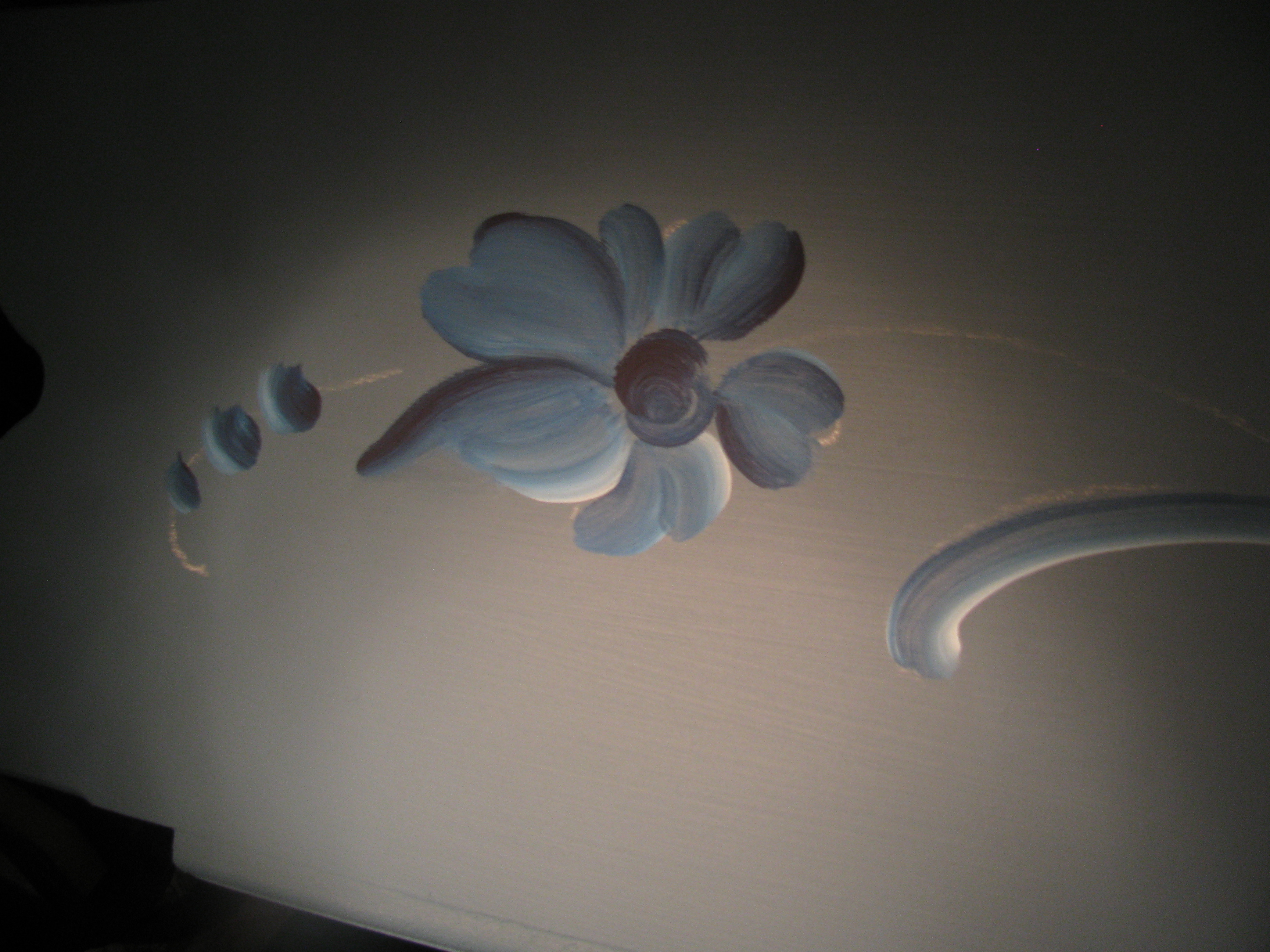
Step 1. Basepaint piece chosen colour scheme. I picked Jo Sonja's Prussian blue and lightened it down with a creamy colour ( JSonja acrylics Smoked Pearl) Two coats. Allow to dry.
Step 2. With non powdery chalk or chalk pencil, chalk in some guiding points, like the root of the design and outside border. If you don't want to paint freehand, you could chalk in the main scroll lines and use a outline for the flowers. Once you get the hang of the shape of the flowers, and what your brush can do, then you can simply mark an x for where the flower will go and its orientation.
You will find a short video here:


Design:
N.B.When designing, keep in mind Balance of shape, size and element. If you divide the design in quarters, there should  be a part of the major elements in each. Each quarter should have an equal measure of postive and negative space. Look at the design upside down to distract your left brain from interpreting, giving you a fresh eyes to see any design faults.
Step 3. Load a filbert ( flat with rounded tip) or flat brush in size appropriate to the width you want the scroll to be in darkest value, on ONE EDGE ONLY. In this case: Prussian blue. On the opposite edge, load Warm white or your lightest value. Flatten the brush on the palette so that the colours mix. Repeat.
Step 4.  Begin painting the scroll from the top down, applying pressure as you go, so the brush widens, and releasing pressure as you near the end of the scroll, as this will narrow the stroke at the design root.
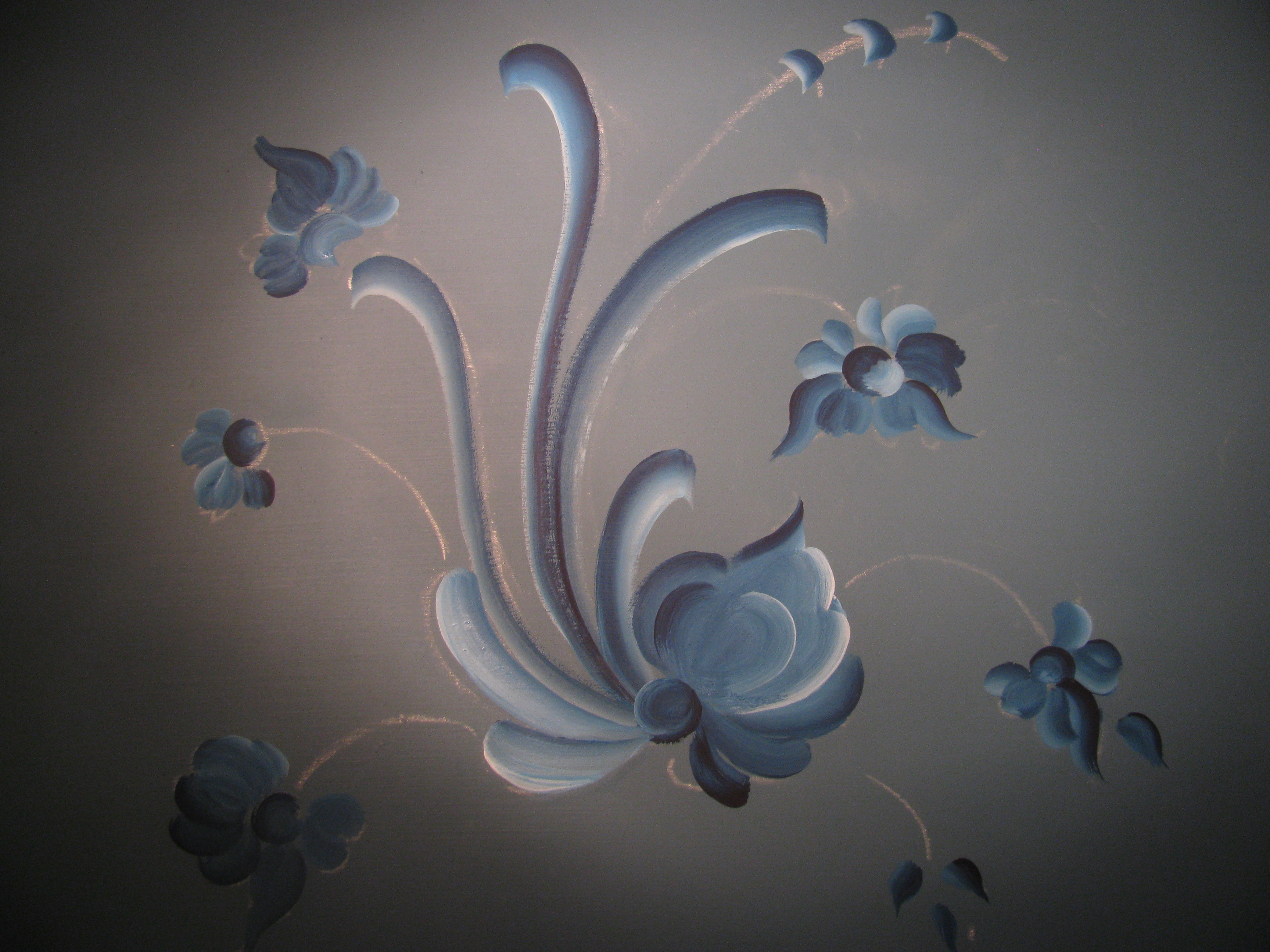
Step 5.  Repeat the stroke if needed, and add extra shade ( the darkest value) on the outside of the scroll, to enhance the contrast. Be careful: Acrylics dry quickly and you may need to use a retarder medium to slow the drying time, giving you more time to play with the design.


Step 6. Paint remaining scrolls in same manner.  Try to have them all merging towards the root point.
Step 7. Begin to block in the flowers using shape following strokes, comma, or leaf shape ( S and C strokes) as appropriate. These can be quite casual and double load your brush again with light value on one side and dark value on the other to give your project a natural blended look. Don't worry too much about shaggy edges here, as the liner work will tidy that up.
This is also a free style of painting, it is not Fine Art, and the peasants that originally painted these pieces had little or no training in artistic techniques. So don't stress trying to make it perfect when it is not meant to be so.
Try to achieve a balance of colour as you go. If the brush has blended really well and the light value is lost, add some extra warm white to your cirty brush (ie. don't rinse it clean in water, just wipe on paper towel to remove excess colour.)

Once you have blocked in the flowers, and are happy with the distribution of colour, you can begin the liner work.
Warning: Liner work is very addictive, and it is easy to get carried away with the embellishments and make the design too busy. Beware! You can always add an extra stroke, later, but rubbing out can ruin a design.
You may also like to try adding something like flow medium to your paint to do some liner work. This will help a beginner. Practise a little on scraps of wood or paper first to get the hang of the brush.
Step 8. Scroll Details
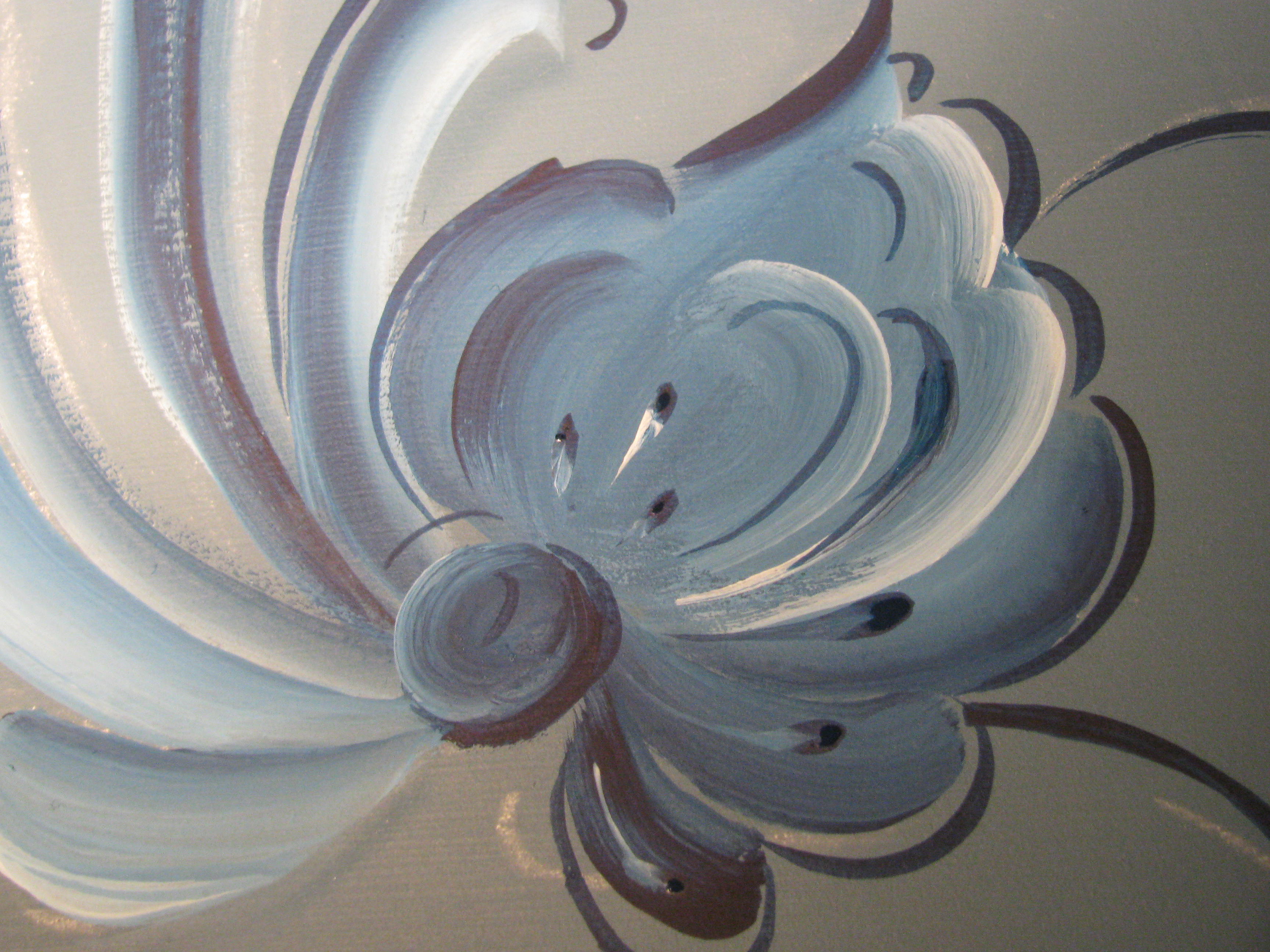
Begin by adding enough water to your paint puddle to ensure a inky consistency. Load the brush in the paint and pull it through twisting it gently a little before you lift it from your palette. Place tip on project and gradually increase the pressure allowing the brush to widen the stroke, then release the pressure as you direct the brush tip towards you.
N.B. For best results, liner work should vary in thickness. The last thing you want is for all the outlines to be the same thickness. Variation creates interest in the design.
Outline all the scrolls in a casual manner. Try to move your arm as opposed to just your hand. This helps to create a sense of movement. Be confident. You can clean up any errors, carefully with a cotton bud or Q-tip.


Step 10. Flower details
Outline flowers in same technique with your liner brush. Be individual and don't follow the same outline each time.
Step 11. Embellishments
Add some small detail strokes with a quill or liner brush. They are completed similar to a reverse comma. Starting off with very light pressure and pressing fully down on the completion of the stroke. I double loaded this brush in the picture here, first loading in blue and then dipping the tip of the brush in white. This gives a white stroke with a blue tip. This stroke is very typical of what you see in traditional rosemaling works. Know when to stop. Overdoing it can make a design look too busy!!
Step 11.Borders
Now you have it! Almost all Rosemaling works have a border design, which can be as individual as you like. I used s strokes around the edges of my box.
All you need to do is allow time for the paint to dry - which can be anything from 2 days to a week depending on weather conditions, oils can take up to 6 weeks to fully dry.
Then a coat of varnish will seal the deal! If you are wondering what type of varnish to use, that is a can of worms to ponder about. Experiment with  a few brands and types to see what works. I like to use a matte or a gloss spray varnish for speed. But equally good are the brush on varieties, or even final coat, which is a wipe on polymer. Oil based paints require oil based ( non yellowing ) varnishes.

Thursday, September 13, 2012

Hindeloopen painting

Hindeloopen painting -a Traditional Decorative Art


Hindelooper art is a type of traditional decorative painting originated in the northern province of Friesland, The Netherlands.
 
It is a form of folk art painted by the maritime community of Hinderloopen, (a small town on the Zuiderzee). During times of bad weather when there was no fish to sell, sailors/fisherman would turn to painting as a way to pass the time and make some money.
 
 
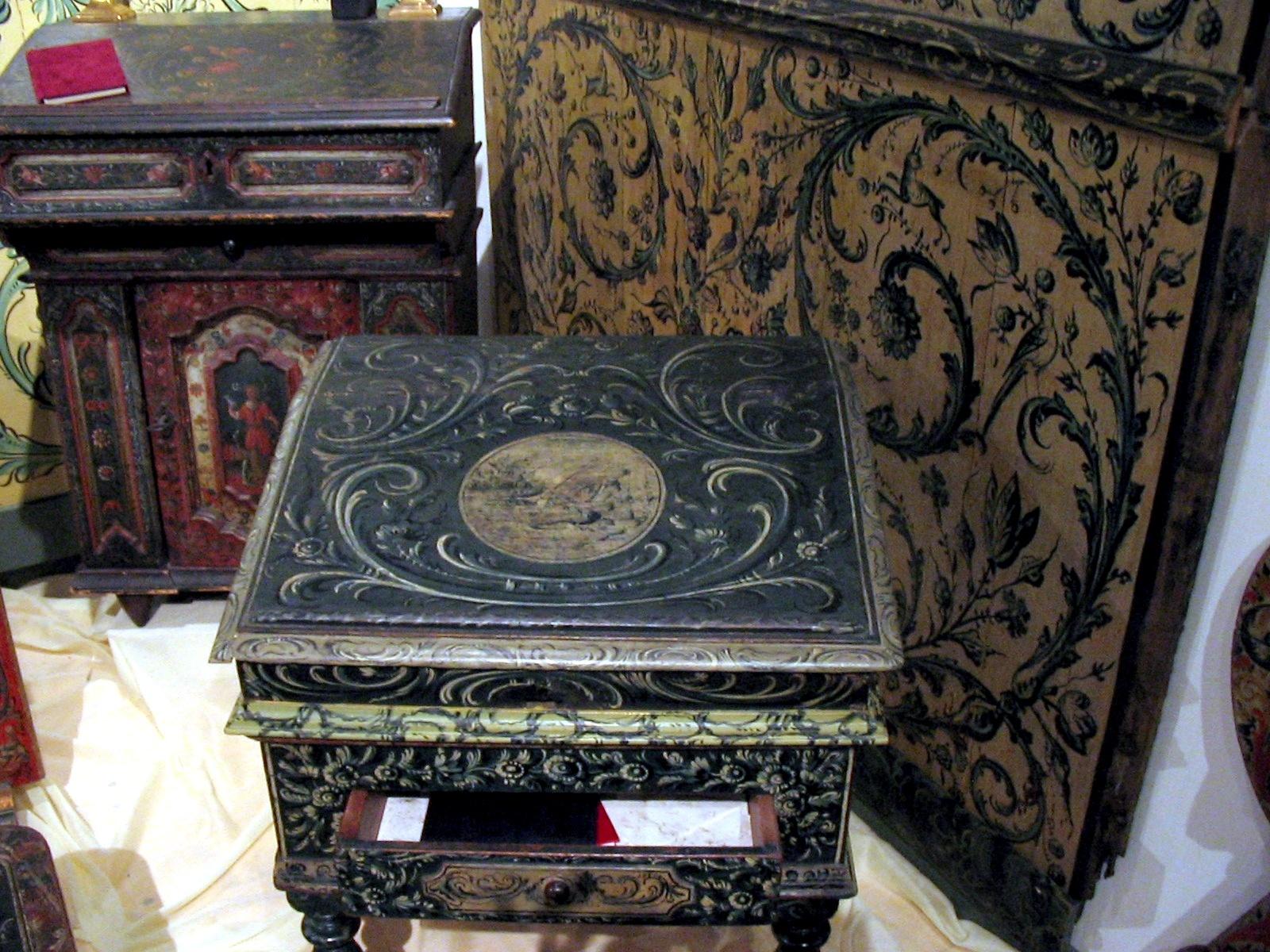
Hindeloopen sailors traded with other Hanseatic league member countries – especially Norway, and often brought home objects painted in other traditional styles that had developed from the Baroque  art, primarily Norwegian Rosemaling.


The presence of these styles in the community, in turn, influenced the development of the Hinderlooper’s own village painting, until it evolved into the Hindeloopen art that we see today. The following pieces are my interpretation of Hindeloopen, inspired by the Australian artist, Heleen Van de Haar.


Hindeloopen Mangle Tray


I have been painting Hindeloopen style of painting and only recently discovered an old family link to Friesland. NO wonder I was attracted to this elegant and very relaxing style of traditional painting.  Traditionally it was the men who did the painting in the village itself, but I so enjoy it. Perhaps the women were so busy with domestic chores they had little time for painting, and it was the men who were stuck ashore in times of bad weather that had time on their hands to create and decorate.

I will include a tutorial on Hindeloopen in the coming months. Something for those interested in traditional art, to ponder about…


Map
Visit Book Blogs

Sunday, May 20, 2012

Syttende mai. Hurra for Norge!!! Happy Birthday Norway

Ja vi elsker dette landet,
Som de stiger frem .... In fact Norway has had three national anthems. The first, written in 1772, by Joahn Nordahl Brun with talk of "blood on the teeth..." Bit scary! But then they are Vikings... Then in 1819, Henrik Hans Bjerregaard wrote Sons of Norway, and finalyy in 1864, Bjørnstjerne Bjørnsson wrote the words in the video which remain the anthem today.....


Not only was the anthem heard, but also "Mellom bakker og berg et med havet" was sung by the Scandinavian singers in the Thyme interactive Restaurant at the Sofitel Luxury hotel in Brisbane today. Why? Because it was a "fest" for Norway's birthday... 198 years old today, (since separation from Denmark) or if you prefer, 107 years since independence from Sweden.... So Gratulerer med dagen Norge. Hurra Hurra Hurra!


The celebration started officialy last thursday, when on syttende mai ( 17th May ) the Norwegian students from QUT university here organized the street march through Brisbane.  This really confuses the people of Brisbane who can't really recognize the flag. I love seeing their facesas all the Norwegians walk along singing at the top of their voices. And street marches are illegal in this state of Queensland, so I like the fact that one can legally stop the traffic in this way.

Thyme interactive Restaurant
And the celebrations really got up and going with the "Constitition Day" buffet at the Thyme restaurant at the Sofitel Luxury Hotel. The roll up each year just gets bigger and bigger!! Over 80 diners this year combined to eat, feast, sing and celebrate. Me included.

Chili Crab
King Prawns!!!
And the seafood on offer would make a Viking proud..... Chilli crab, Prawns the size of a large man's fist (scandinavians take note!) Whole baked snapper, Mussels, Oysters, Salmon, Scottish peppered mackerel, as well as several roasts, pappadums, curry, salads, veges and I won't begin to discuss the desserts. I will let the pictures tell the story...
Desserts to die for....

Now I am several kilos heavier, and that is something I don't want to ponder about for too long.... What I will ponder about is that England stuck its nose into Scandinavian affairs making Norway war spoils in return for Sweden backing England against Napoleon. In fact, forcing Norway to accept Swedish control or else they would blockade all imports to Norway in 1814. What bastardry was this? Forcing people to starve so that they could win economic and political advantage in the region? Abhorrent. And dare I say, typical of England self important ego.

So this is how Norway had to wait almost another 100 years until they gained full independence as a country.  Not a good day for Napoleon, Denmark or Norway. I guess a good day for Sweden!!


Saturday, March 10, 2012

Oberammagau - Oh my God!!

Statue of Ludwig 1 - the great builder of Munich architecture


Map


Linderhof Palace


Munichers have a strong sense of nationalistic pride and a history buff like me can feel a haunting sadness in this city. Is it just me, or do I detect covert elements of of national socialist sentiments still present in  this very modern fast-paced workaholic environment?  The history of the city with its Greco-roman architecture – the legacy of King Ludwig’s father Maximilian. The son, Ludwig 1 had to abdicate because of Lola Montez 
Footnote from Wiki: Eliza Rosanna Gilbert, Countess of Landsfeld (17 February 1821 – 17 January 1861), better known by the stage name Lola Montez, was an Irish dancer and actress who became famous as a "Spanish dancer", courtesan and mistress of King Ludwig I of Bavaria, who made her Countess of Landsfeld. She used her influence to institute liberal reforms. At the start of the Revolutions of 1848 in the German states, she was forced to flee. She proceeded to the United States via Switzerland, France and London, returning to her work as an entertainer and lecturer. For a time she visited Australia.
Her alleged affairs included not only a Russian Tzar, and Liszt, but also Australian miners, no less.­­ And Ludwig's son, and successor, Ludwig II, went mad and probably committed suicide... and it is his palace that we visit later today.  But first, The bus drove up Maximillian strasse ( with its designer schiki mikke stores) and then Ludwig Strasse (named after the first Ludwig) and saw the state Library, Ludwigs' church, and the University. Also Michael, the bestest bus driver, stopped briefly outside St Peter’s church where the bones of some Saint were venerated in Gold!!!
Dindl and accompanying scarf = 205 Euro


Traditions in Germany
Instead of speaking of Santa bearing gifts at Xmas time, they might ask, "What will the Christ child (Christkindl) bring you?" Krupesch is the helper who comes knocking at the door. In years gone by, he would ask the children if they had been good during the year, and if so, he would give them a gift, and if not, the children might be rewarded with a whack with Krumpesh’s stick on their behind. This Christmas tradition is also found in Austria, and some young children today, are scared witless, such that they hide under the table. 

Traditions are not forgotten as many women will attend Christmas or special events wearing the Dindl, but as with other national costumes, they are notoriously expensive: A dindl scarf costing 205 Euro but it will last forever!!

Deeply proud, righteously religious, abrupt, hardworking, food with lots of cream are some of the words used to generalize about these people. A sense of superiority pervades their mindset and this is no more apparent than in the  architecture, grandiose buildings reminiscent of Greco-Roman empires. Bavaria has been a separate state for 800 years. This trickles through the Bayern consciousness even now. In Victualmarkt, several group members had been reprimanded severely for touching items on display. The sign, in German, was too verbose to be clearly understood. A central maypole is usually seen here too, but this was taken down, due to rot!!! We saw the remnants sawn through, on our morning stroll the day before. Normally it is painted blue and white, the nationalistic colours of Bavaria. The German eagle watches suspiciously over all in his field of vision.

Allotments are a way of life here, especially for apartment dwellers. Surprisingly for Germany, Frankfurt allotments were rather untidy, but here in Bavaria, the have been maintained to a good standard. The famland around Munchen are clearly postcard picturesque. In efficient German style they are neat and tidy, and green rolling hills are a predominant feature. Swiss style housing can be seen in Bayern, surrounds as well as old barns ( still neat and tidy ) with a tiled roof. The Bayern/ typically swiss cantilever balcony in wood also feature heavily, with whitewashed walls and timber fretwork shutters and timber -framed top storeys.

Food
Germans also love their meat, Leberkast ( Roast lamb on a bun) can be had for as little as 1.50 Euro. Order some Kartoffelsalat and Broet with a kaffee/cappuccino for only 3.90 Euro at the Hofbrauhaus!!!
 
Taverna del sud was the restaurant of choice in Munich, an Italian tavernetta, quite popular with locals. We were accompanied by two of the single ladies on our tour. One lady from Sydney, a corporate secretary, with a hilariously named poodle called Dave and the other lady from Melbourne, a nurse with a son who was an artist. Thin crust pizzas, lasagne and very good House wine ( Red ) was very reasonably priced, at 2.30 Euro and we had attentive service from an Italian waiter, but don’t ask him about his personal reasons for coming to Germancia.   Suddenly he does not know a lot of English!!!  

Footnote: German wines are apparently very good, as they should have had years of practice perfecting their skills and located between Italia and France, they must have picked up some hints!! The word is that the good wines are kept for consumption, and exporting only the wines that are crap…. Something that is also for home consumption and difficult to import ( at least into Australia) is the Lebkuchen, which can only be translated to Gingerbread, but is more akin to Cake than biscuit.   
As previously mentioned, in the Rothenburg**** post, they can keep their Snowballs, yuk yuk….but the Super Dickman ( super meaning large) will be gratefully accepted and purchased at will.


Road to Oberammagau
It is no surprise that dairying is the main industry here, butter, cheese, milk all contributes to the quality of the cakes here….!! Every few kilometres one sees a Romanesque or Baroque church, with the onion dome tower so typically seen in deeply catholic Bavaria!

Oberammagau
Farmland around Munchen consists of rolling green fields, housing thought to be typically Swiss, consisting of White walls and timber framed upper storey, with timber fretwork cantilevered top  storey  verandahs, and painted facades on white walls with shuttered windows. firstly without painted adornments, neat old barns, with tiled roofs. Surrounded by vast tracks of coniferous forests. And all the while, the fantastic  backdrop of Alps, which stretch for 1600 kilometres through France Germany Australia Slovenia and of course Switzerland.  No wonder Hitler had his Eagles nest here, he must have felt like he was on top of the world and wanted to won it all…….­


Oberammagau is our lunch stop and besides the enormous and gob smacking range of painting on the houses, mostly religious in orientation, there is some wonderful shopping to be had here. The town itself is where the very famous Passion Play is held every 10 years. The history of which dates back to a promise the towns people made if the almighty spared their town from the Black death. And to this day, the people keep that promise alive. Hugely popular amongst tourists and pilgrims alike, Oberammagau is a delightful small village set in a picturesque part of the alpine region of Bavaria. 

Ettal Monastery
Inside Ettal

A wonderful extravaganza of Baroque art, the epitome of White and Gold perhaps as with a lot of Catholic churches, a perverse history of sexual abuse of young boys..
Gothic churches were designed to separate the general public from the monks by a central crosspiece (Division of the nave) but in the baroque style the altar is uninhibited and design streamlined.

Wiki tells  us: Ettal Abbey is a Benedictine monastery in the village of Ettal close to Oberammergau and Garmisch-Partenkirchen in Bavaria, Germany. With a community (as of 2005) of more than 50 monks, with another five at Wechselburg, the Abbey is one of the largest Benedictine houses and is a major attraction for visitors.  Also on a less tasteful note:
In early 2010 ten priests at the Ettal Abbey boarding school were accused of sadistic beatings, molestation, or making sexual advances on boys as well as sadism. In March, 2010, authorities raided the monastery as part of a probe into allegations that priests sexually abused children there [CNN: [1]. By an Apostolic Visitation and an independent investigation these allegations have been surveyed and consequences have been drafted. The major part of abuses have taken place in the late 60s, the 70s and the early 80s.

Linderhof Palace and King
Mad King Ludwig, himself

Ludwig

 Mad King Ludwigs reign began when his father died prematurely and so he became King at an early age. Known for his eccentricity, he built 3 fairy tale castles, the most notorious being Neuschswanstein, a magnet for tourists. However today we were to visit the smaller palance of Linderhof, where Ludwig was to spend the last 10 years of his life, in seclusion, prior to being admitted to a psychiatric facility.

Really he was an utter weirdo, but handsome and turned quite strange around ugly people, to the point where he made ugly servants wear masks! He did not finish his study and had no friends his age. The deaths of his tutor and Father at roughly the same time, affected him greatly and he would undertake no diplomatic duties much to the chagrin of his advisers. Homosexual and completely anti – social, his palace at Linderhof only has one bedroom and is the only palace he was to complete in his short and tortured existence.

Finally he was declared insane and was committed to an asylum outside Munich, where he was given to take long walks with his Doctor late at night and one night they were both found drowned in the lake, despite the fact that he was a good swimmer. The exact circumstances remain unknown to this day. It was commonly thought to be a joint suicide.  Politically, this coincided with the combination of Prussia with Bavaria, which ended Bayern isolation as a separate state and opened the door to Bismarck's German empire and the first German parliament in Frankfurt!!


The chapel at Linderhof

Gardens and fountains at Linderhof
 Here is what my an eleven year old wrote about today. I was so impressed by details I have missed that I wrote it here:
Then we were going up into the mountains today. We were going to a king’s palace. His name: King Ludwig. He became king at a young age of 18 years! He was very good at sport and lots of people knew him. But when he became king he became very sensitive and depressed. People said that he was an odd fellow and didn’t like to be seen so that was a problem of being king. He was very handsome but he wasn’t a very nice king. He never entertained only for himself and sometimes in the middle of the night he would wake up and say for example: I want to go sledding tonight. So all of his servants would have to get up and go sledding with him because that was his orders. He made a few castles, but we were going to the smallest one. He made it very hard for people in the public to find him so he put it up in the mountains so it was very hard to find. We walked up a long walk way but it was worth it. The castle only had 12 rooms. We first went into the living room which is the starting room. Before we went up the stairs we went through a second room which had 3 million dollar vases. One huge from Paris and 2 smaller ones from China, so if you broke one you would probably be broke. We went up to the first room. It had a peacock which was his favourite animal and instead of using a flag to symbolise that he was home he would put the peacock out the front which was different. The second room didn’t really have a name but it had a large wooden chair at the front and a velvet robe at the top. The next room we went into was his bedroom. He had a massive bed the colour of blue (which was his favourite colour) and 2 small vases from Paris. The room next to his bedroom was the dinner room. There was a lovely wooden trap door and there was a table that went with it and there were pulleys attached to it so because he never wanted anyone to see him they would pull the trap door down to put the food on and then when he wanted dinner they would pull it up. The next room was called “The room of mirrors” They had 2 mirrors reflecting off each other so it looked like the room went on forever. There was a bid couch which was blue and he would sit there and read his books. Then we walked out of the room and down some secret stairs. Then later on they said that the public was sick of him being king so they tried 2 times but he had two many guards so he was protected very well. One day he went for a walk with his doctor (they went on frequent walks) and he never returned. Later they found him and his doctor drowned in Lake Chiensee. The public was very surprised because Ludwig was a very good swimmer. Some people said that he slipped and fell and his doctor came in too. They also weighed his brain but it was very light. After Ludwig died there was no one to run the kingdom and he never married or had children Ludwig’s Grand farther took over and when he died it was a long time before a new king was chosen.


Visit Book Blogs

Saturday, February 18, 2012

Day 4 - Winter Wonderland Tour Day 1


Sunny tending to Overcast was the weather prediction and it was about 2 degrees when we set out to explore Offenbach proper. We walked northward, or at least we thought it was northward and happened upon a farmer's market, where we found a plethora of advent wreaths and candles. Little did we know that this was going to be a common occurrence in the weeks to come. 


Our breakfast had been huge: Smoked salmon, herring/ cheese/and chocolate banana muesli. I could get very used to that!!! Delicious mouth watering pastries/cake/fruit as wellas hot dishes and the most scrumptious pretzel buns. My new favourite food!!


Significant attractions this morning included many buildings and fine houses and a delightful church with wrought iron gates. Some of these manor houses are quite large and some built post war, others' obviously pre dated the war or were rebuilt afterward, as Frankfurt was fairly heavily hit in WWII. 


Something unexpected was the appearance of Peter Parker a.k.a. Spiderman and of course the landlady or spouse in the apartment above was dutifully cleaning the windows. ( An obsession that is purely German, I think). 

Schloss Offenbach is the largest manor house of all in Offenbach.
Dating from the 18th Century, it overlooks the river and the barge fleet, and appears deserted but is open on some occasions, according to the sign on the door. The orange paintjob is a little perplexing and I do wonder what the interior is like..... 


The Offenbach equivalent of the Gallery of Modern Art, was closed but H. was pleased about that as she thought the building was creepy. The leatherworkers museum was open but did not look enthralling enough for us to spend time there. A rather weird structure sits outside, but keep walking along this street to see some really fantastic suburban architecture and manor houses. Must have been studying history for too long, as I could see German soldiers or SS trotting about with their boots on, in the ever present piles of Autumn maple leaves that seem to be omnipresent in this part of the world.  On arrival back at the Sheraton Offenbach hotel, ( via the mall and the Xmas markets), we checked the free internet in the lobby and met up with our tour guide, Sue Mason. 


On tour of Frankfurt proper, we were introduced to modern Frankfurt The Euro bank ( in the news predominantly at the moment) tent city, Financial Deutsche Bank HQ with the affectionately named 'credit' and 'debit' towers, and our final stop which was to be the most exciting of the day. 

We found the bus that was to be our quasi day home for the next 9 days was roomy and comfortable. We ended up the back, opposite a couple from Texas, and in front of a Brissy couple who were headed for London for 2 years who alighted with us at the Frankfurt Xmas markets.....

Well it was a Saturday but an ocean of people greeted us. It was all but impossible to make your way around. I felt like I was back at sideshow alley at the Royal National Show. Most items were a little expensive compared to Offenbach, but we did find a few souvenirs and H. bought me something for xmas on the sly. ( Dear little thing) Food wise there was opportunities to sit and drink gluhwein, for 7 euro and you pay a deposit, refundable when you return the cup, but who has time to sit when there is so much to see and so many people to squeeze past!!! I did grab a  baked potato with dill sour cream sauce and that filled me up!! 


The Romer square or Romerburg is something to see, even with a sea of people. The quaint half timbered houses were amongst  the only few buildings untouched by the bombs as a postcard in one of the shops grimly testified. The city was reduced to rubble, and I mean rubble, except for the Romer square timbered buildings that we see today. Imagine how pretty Frankfurt would be if it all looked as the Romer does. 


Don't miss the Romer round church if you go to Frankfurt, and the city hall is somewhere you can whip around in, in less than 5 mins.  The first German parliament of the unified Germany 1832 and 1871. Inside some of the shops were gorgeous and had the old world charm happening bigtime, and others, no different, and had been thoroughly modernised.  


The good: Romerberg square original houses and Round church
The Bad:  High prices at the Xmas  markets
The Ugly: Very touristy and worse on a Saturday

Tuesday, December 21, 2010

Mint leaf or Chocolate freckle tree.. Good edible activity for children.


When my children were young, we always had time to prepare some special kid friendly treats. Even my 18 year old exchange student liked this one....

Make a quick edible Xmas tree with the following recipe. You need icing sugar, ice cream cones, some lollies and and egg white.

This is great if you want to keep younger primary or preschool kids amused during the holidays.... You can even coax those totally uninterested in cooking to participate as it involves sweets! Good for talking and learning about measuring and weighing, heavy light

Children will have fun making and spreading the icing, making the star and then ultimately eating the finished product!!! The recipe could be adapted to more healthy variations, using nuts or fruit!

Mint Leaf Xmas tree
1 egg white
1 1/2 cups icing sugar
6 ice cream cones (triangular pointed variety)
400g mint leaf sweets or similar sweets
silver cachous

Sift icing sugar into bowl. Place egg white and 1/4 of the icing sugar in bowl, beat with electric mixer till well combined, add remaining icing sugar in 3 batches, beating well after each addition. Icing should be stiff but spreadable.
Cover icing with  a damp cloth.

Join three long triangular ice cream cones together using a little icing sugar between each one.
Repeat with remaining three cones.
Starting at the base of the the cones, spread icing over one third of cone.
Place a row of mint leaves around base of cone.
Spread more icing over middle of cone.
Place a row of mint leaves around cone, overlapping the first layer.
Spread remaining cone with icing.
Continue arranging rows of mint leaves around cone until about 6 or 7 rows are formed altogether .
Leave a little space at the top. Cover top with silver cachous.
Repeat procedure with remaining icing, cones and leaves.

Sprinkle extra icing sugar over trees.


 VARIATION:

Chocolate Freckle Tree

1 egg white
1 1/2 cups icing sugar
Green food colouring
250 g chocolate freckles or similar sweets

small piece white cardboard
glue
silver glitter.

Sift icing sugar into bowl. Place egg white and 1/4 of the icing sugar in bowl, beat with electric mixer till well combined, add remaining icing sugar in 3 batches, beating well after each addition. Icing should be stiff but spreadable. Colour with food colouring to simulate the Christmas tree.
 

Cover icing with  a damp cloth.


Method:


Join three long triangular ice cream cones together using a little icing sugar between each one.


Repeat with remaining three cones.


Starting at the base of the the cones, spread icing over one third of cone.


Place a row of freckles around base of cone.

Spread more icing over middle of cone.


Place a row of freckles around cone, overlapping the first layer.

Spread remaining cone with icing.


Continue arranging rows of freckles around cone until about 6 or 7 rows are formed altogether .


Leave a little space at the top.


Cut out a star shape with cardboard, spread with glue and sprinkle with glitter. Spread back of star with icing, and place on tree.


This recipe can also be made with White chocolate truffles and cream cheese or peanuts and coconut....you are only limited by your imagination!! Something for our stomach to ponder about in the silly season!

Monday, November 22, 2010

Rosemaling plate Oils/acrylics Rules and Telemark Technique

Rosemaling - the traditional painting of Norway!

Ah, the joy of painting. So little time and so many pieces of wood to paint.... the folk artist's lament! Determined to get something painted this week, I traced a pattern on a base painted plate. I will share a few of the secrets to successful painting here.

For more on the history of Rosemaling, click on this link:
http://forestwood.webs.com/norwegianfolkart.htm

For the uninitiated, oils are quicker to paint because they blend so easily and beautifully, but take up to six weeks to dry....

On the other hand acrylic paint dries fast, does not give so much coverage and as for blending colours and shading/highlighting in acrylics.... well that has developed into an art form all by itself. It can be difficult to get a gradual blend of acrylic colour, even with chemical assistance such as retarders and various mediums that assist you to work the paint while keeping it open... that is slowing the drying process down. This can be an advantage and a disadvantage. Acrylics can be varnished several days after completion, but can easily develop holes or harsh shading lines. Even using wet -on-wet, you sometimes end up with a muddy mess that is much easier to avoid with oil paints.

I had the pleasure of guidance and tuition in Telemark techniques, from a great Norwegian friend, Mr Bjoern Pettersen, a master Telemark Rosemaler from Drammen, Norway. In painting this plate, I have followed his technique and palette. You can see some of his work here:
http://www.rosemaleklubben.org/main.asp?page=Galleri


My palette is set out according to colour family, each in the centre row, with respective shades above and highlights below, and of course, the Basic colours on the left.


Rule No. 1
Colour Harmony Choose your palette wisely and don't be confined by the cool/warm colours of contemporary painting.
Bjoerns Telemark Colour families consist of green, red, blue and yellow family colours. He has developed this palette himself and it works wonderfully well in the traditional sense.


Painting Technique
First I laid in the scrolls, with their respective shade and highlight. It is none too balanced here, but I promise you that will come later. Scrolls are painted with a long handled flat brush in a Pettersen technique.


Rule No.2
Always paint for balance, so that if you divide your piece into quarters, each colour family will be represented in each sector.


Next step involves the application of paint on the flower and leaf shapes.
This requires the painter to paint hearts or half hearts, scrolls and c strokes to form flower shapes. I also like to paint the two shapes at the base of the flowers green, as they symbolise a flower calyx, (or small petals located at the base of the flower in nature, for those botanically challenged readers!)


Rule No. 3

Aim to not have the same colour family next to each other in painting each petal.... calyx excepted! You can see in the above photo, that I broke this rule, (the rebel that I am inherently am) beacause I was a little stuck and have 3 greens next to one another, but it looked ok and was necessary to qualify Rule No. 2 "Balance".

Posted by PicasaFlowers and scrolls completed

Now is the fun and most individualised part of Rosemaling... you can add your embellishments.... you can be as busy or as quiet in applying these as you like. This is what makes each piece your own! When I first started painting Telemark Rosemaling in oils, I tended to overdo the embellishments.... and the design can then become overwhelming and too busy. Bjoern helped me to know when to stop when painting embellishments and extra touches...


Individual embellishments on scrolls and flowers

Rule No. 4
Know when to stop with embellishments


Now all one has to do, is sign your work, wait for the oil paint to dry and then varnish....!!! Your project is complete.

Feel free to contact me with any questions on the comments box below....

I hope this blog post has provided some insight into this little known art form, which for me is mesmering in its dynamic impact on the eye. Something for painters to ponder about.

Happy painting,
Amanda