Showing posts with label tourist attractions. Show all posts

Monday, October 8, 2012

Travel Diary - Part 8 - Salzburg to Innsbruck


A sunny but cool day, ( perfect weather for me) greeted us as we set off from Salzburg, along the Salach River, travelling for the most part, along roads fringing the Bavarian Alps. 'Ach' means water from the glacier, so you can imagine the colour of this particular river. It was an ice blue, from the particles of small rock washed down from the glacier. Just beautiful.  Austria, on the whole, is such a delightful country, so pretty and not well known in my part of the world. I guess it struggles a little economically, particularly with the spectre of the current GFC breathing down its neck, and thus I often saw the sign “zimmerfrei” for rent on the village houses. Much prefer this to a hotel style accomodation don’t you? These houses are full of character.

Our guide and bus driver had colluded together to see if they could find us some snow to look at, along the way to Innsbruck, as we were all looking forward to a winter wonderland, which had not as yet, arrived as yet. So they took us along a back road through Bad Reichenhall and the Lofer Mountains, magnificient Tirolean scenery, along ski road and lodges, dotted here and there with artificial snow, made from machines. Well, I guess that they had to have something for the early winter guests to do?!!! I was happy to see any white stuff, frankly....


The Castle Fratzholz ?sp is found here, in the Tirolean region. It was the where the Nazi's stored much of the famous paintings/works of art stolen from Europe during Hitler’s reign.  I noticed the Tirolean churches here are mainly comprising a Baroque form, with a round chancel (is this called the chancel or the nave?) comprising the altar area. Really like out of a Grimm's Fairy tale.
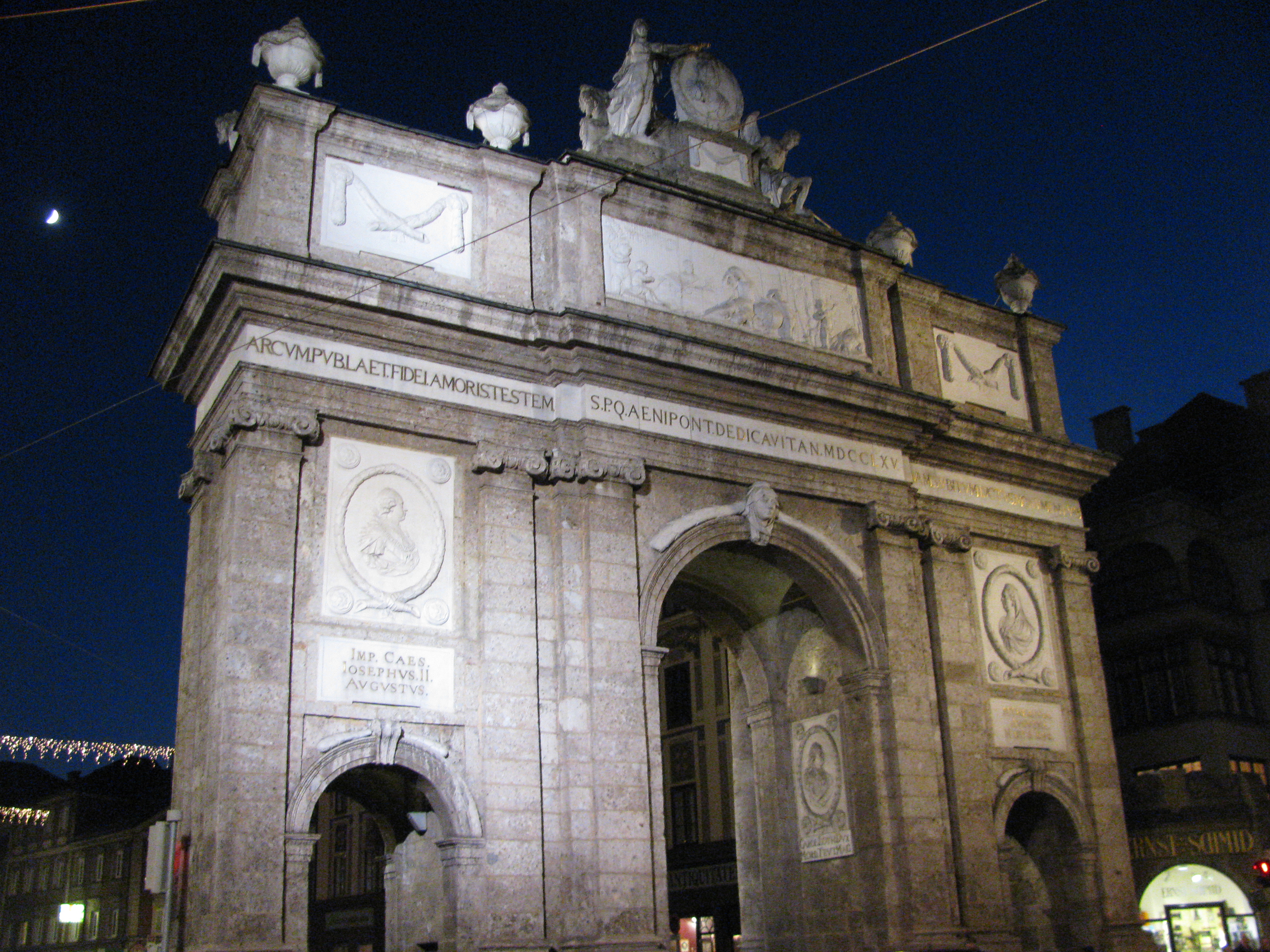
 
Historically, the Hapsburgs ruled Austria and Innsbruck in the 1200′s  right up to the 1500/1600′s. This was a time of Roman Empress Maria Teresa, and the triumphal arch situated at the south end of Maria-Theresien Straße, which was modeled after roman archetypes, was built by the Empress on occasion of the marriage of her son, the Duke of Tuscany, later Emperor Leopold II, to Maria Ludovica from Spain. The marble reliefs were created by Balthasar Moll in 1744. The ones on the south side show Leopold and his bride Ludovika, the ones on the north show Empress Maria Theresia and her beloved husband, Francis I Stephen of Lothringen, who sadly died during the celebrations. Times have not always been so rosy since, however. Despite losing almost all its territory and empire during WWI, there are still some success stories in Austrian business. Red Bull, Geiger, and Swarovski are all Austrian companies.

Innsbruck has a population of 118.000 and is at 1,985 ft /605 m above sea level.  Entering Innsbruck, you can't help escape seeing the enormous Ski Jump and the Patscherkofel Mountain which we guessed, most of the skiing takes place.  This is 7,381 ft or 2250 m, and I imagine there would be heaps of black runs or skiing off piste!!!  
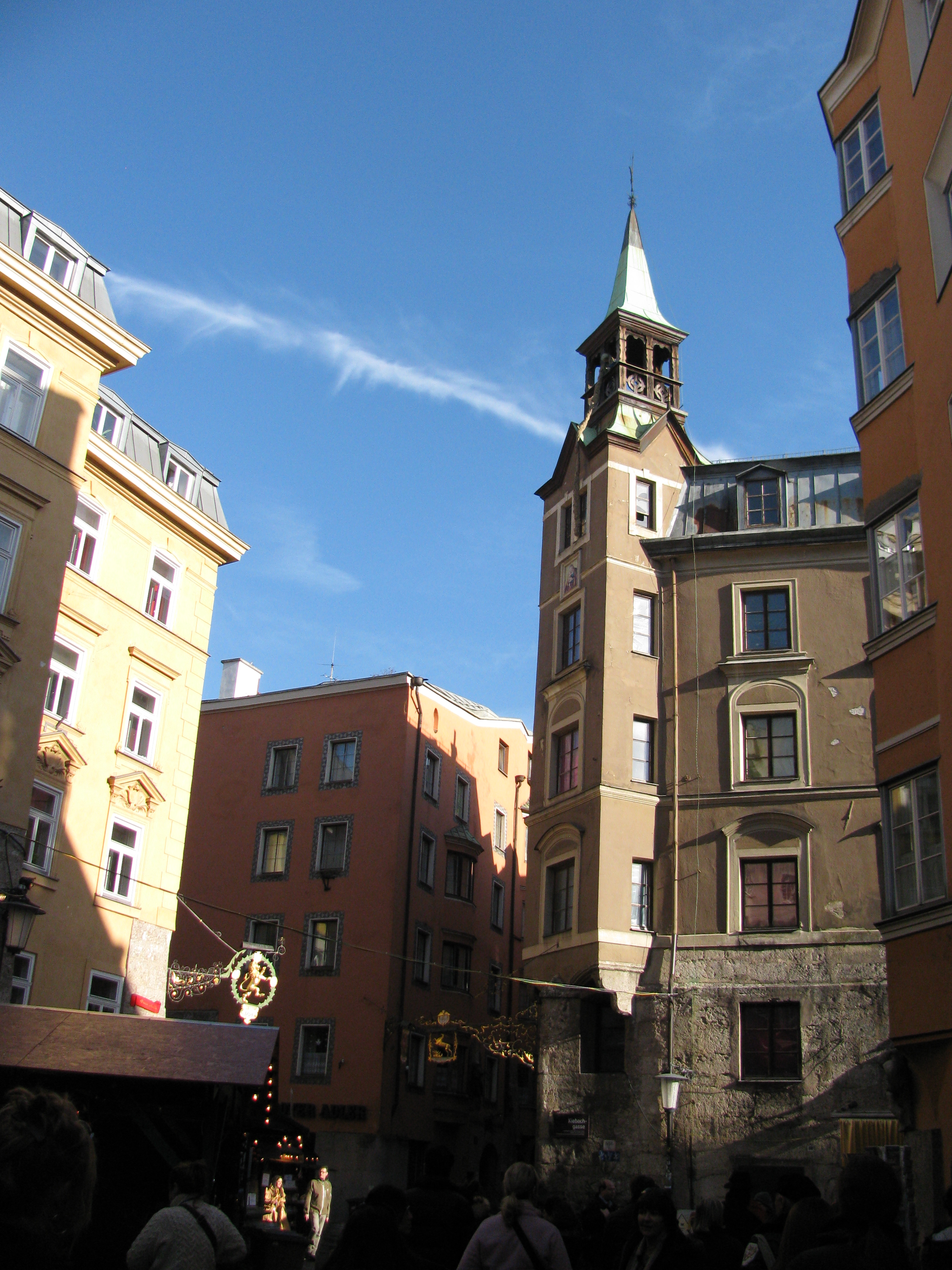


Arriving in Innsbruck there was loads of free time in the old town doing the mandatory tour of the old pedestrian streets and arcades, seeing the famous Golden Roof, made from 2657 golden plated tiles and all those fabulous Rococco buildings. . The areas around Innsbruck were, for many years, mined for metals, and this was the source of the economic base for the development of the Austrian empire. No doubt some of the gold from the Innsbruck hills, made its way into those 2657 golden tiles). Our hotel was centrally located right next to the Triumphal Arch an architectural remnant of Maria Therese’s reign.


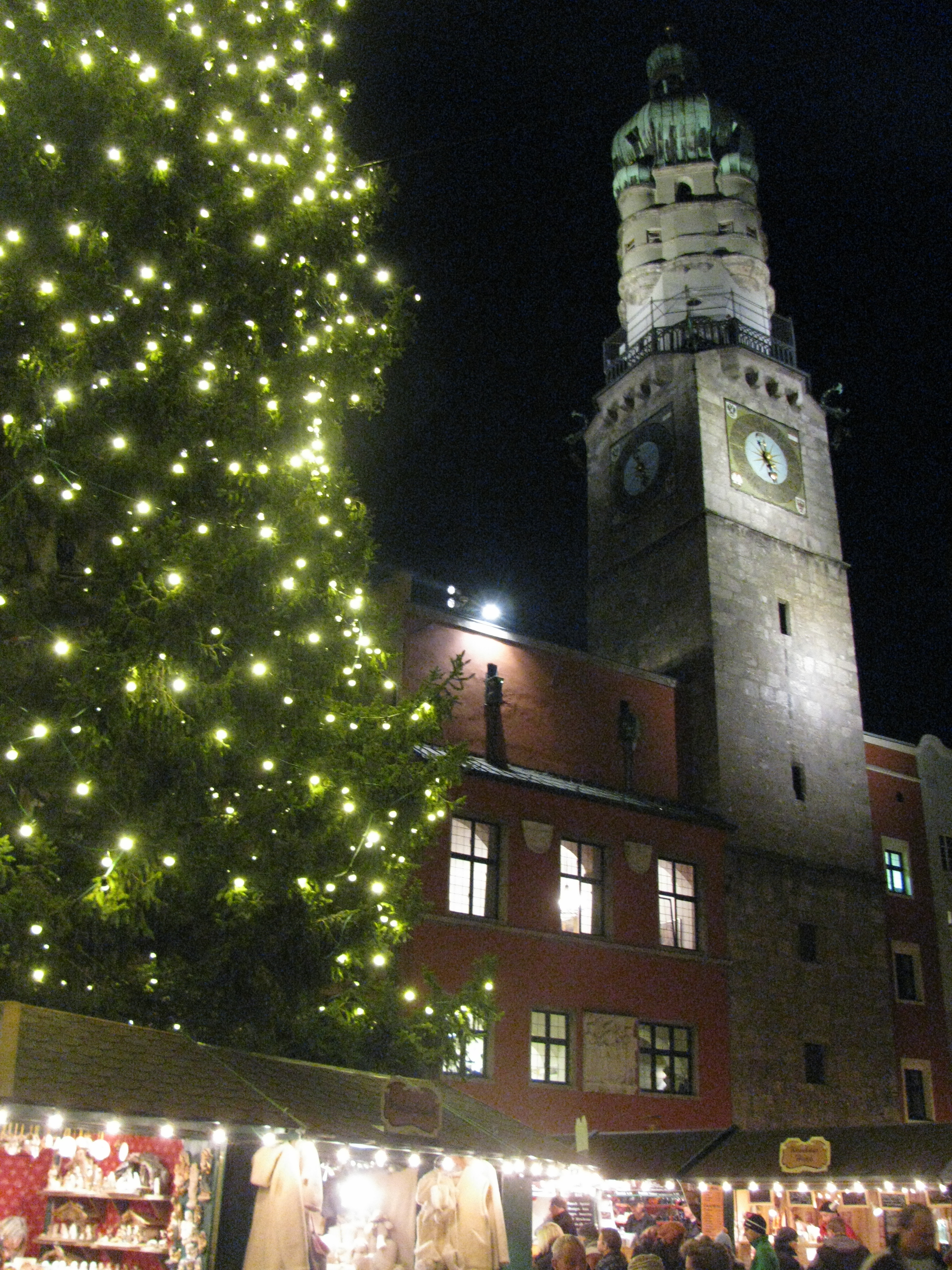
 There was a lovely atmosphere to be found in these streets, as the Christmas markets predominated already in early November. I found a great soft leather wallet, with just the right amount of compartments at one store, for a fraction of the price I would pay at home at a street stall in the Xmas market. On the whole, the shops were expensive by home standards, but in the pedestrian street, you will find some department stores with bargains on certain items. I found a fabulous Kugelhof cake tin for a mere pitance. Some beautiful fabric too: elegantly patterned monochromatic Christmas tablecloth fabric, of the likes completely unobtainable in Australia.

There are often street entertainers too, some are a little strange, like two guys dressed as a Madonna and child and ?feminine male partner?? Still a bit confusing for me....


When searching for a replacement piece of luggage (damaged by porters!) in an Innsbruck retailer, we found the most amazing folk art painted cupboards and dresser, painted in 'Alpbachtal' style. The shopkeeper told me that she had already had one dresser restored, but she was not happy with the results of that restoration, as she felt it did not do the art justice, so even though her other cupboard is dark and has been antiqued by age, she will not have it restored, as it will still retains the special beauty of the original brushstrokes.  I think I agreed with her.


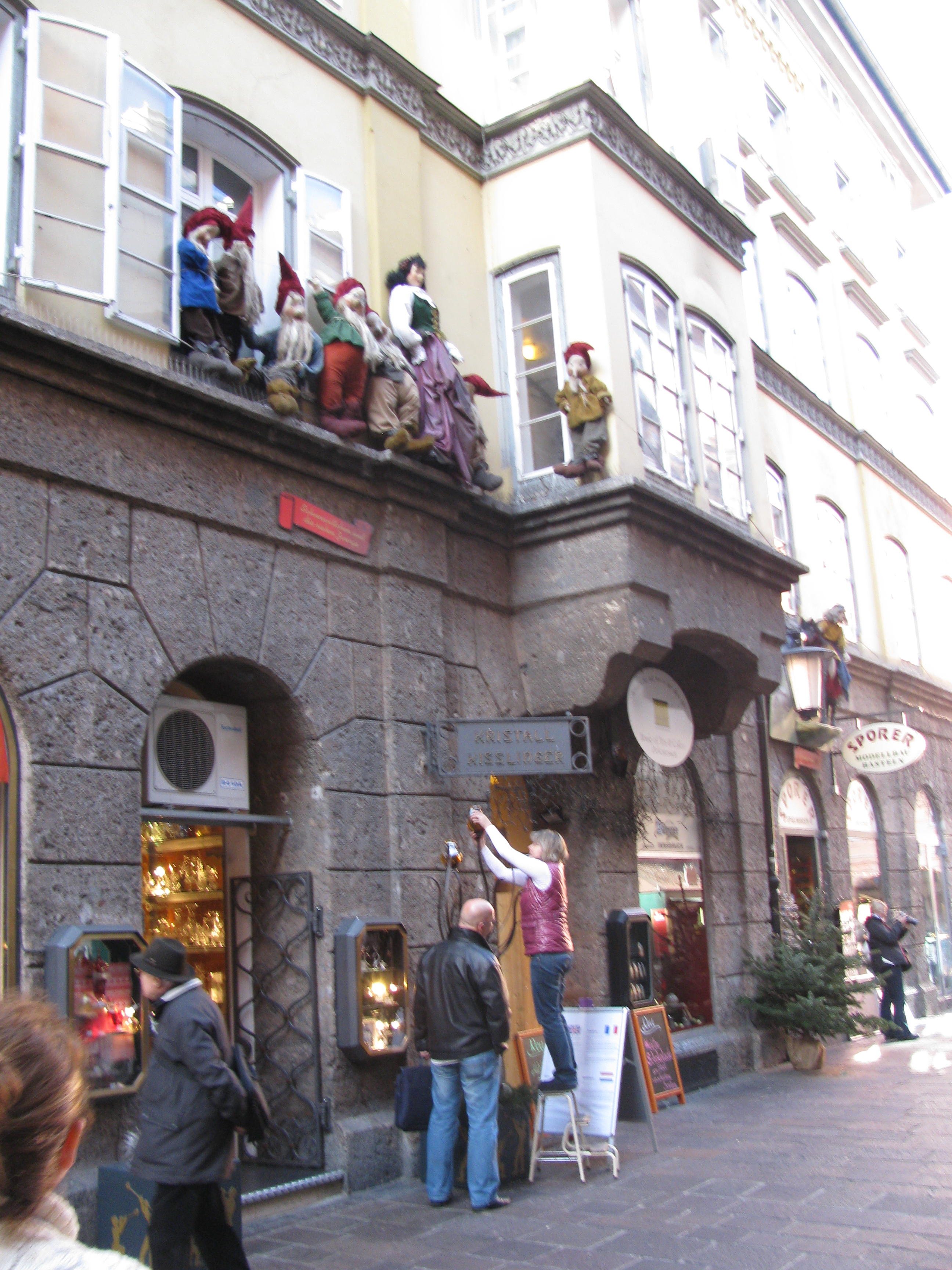
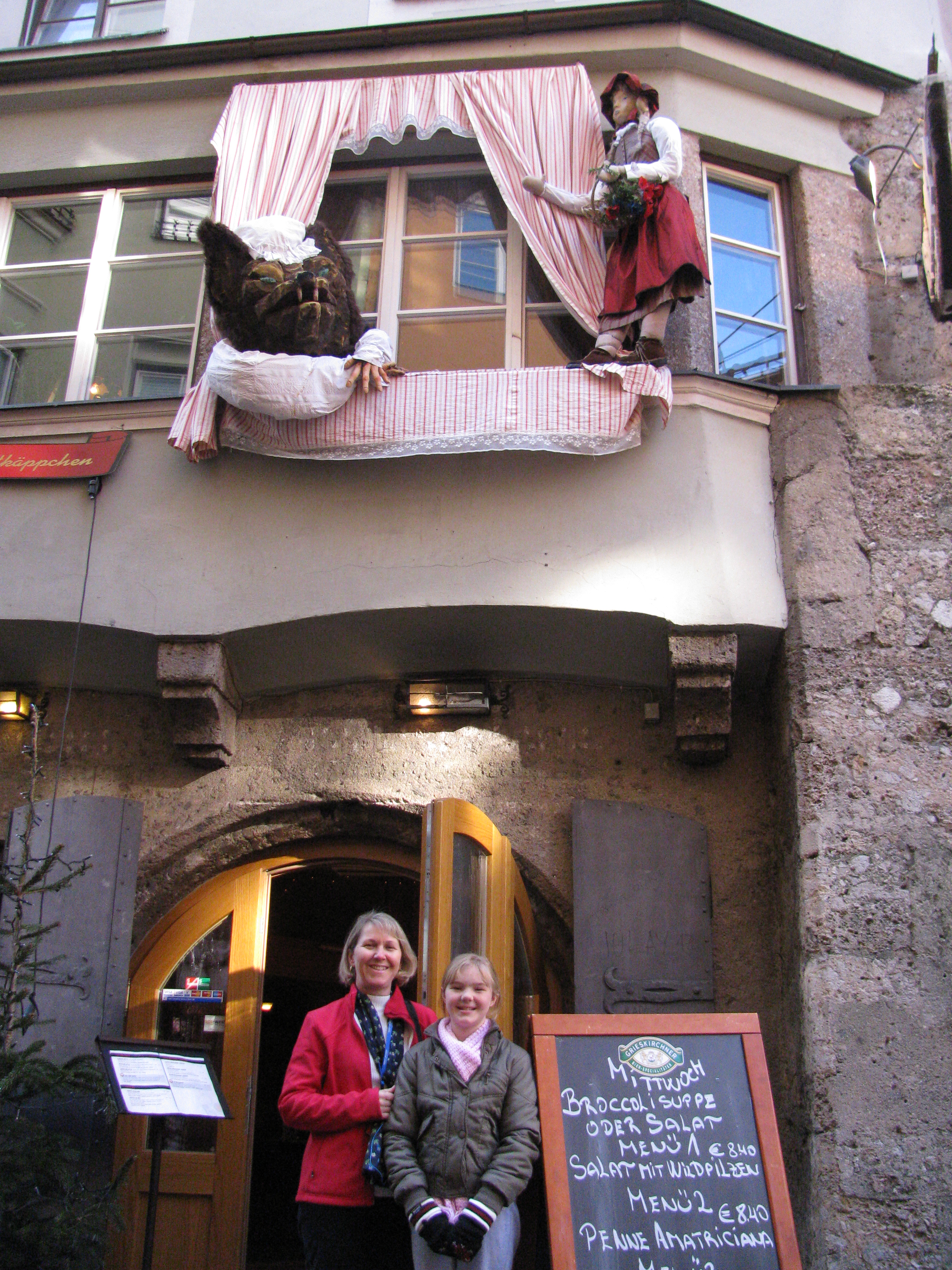
The fairy tale becomes real in Innsbruck at Xmas time as the towns people decorate windows and walls with characters from the German fairy tales such as Snow Queen, Hansel and Gretel and the Golden Goose. 


During the free time in Innsbruck, most of the females of the species practically ran to Swarovski to grab some jewellery bargains. Having a bit of Norwegian silver, I opted to go on the afternoon optional excursion to an authentic Austrian farm on the hills outside Innsbruck, called Axams. Another wonderful example of an unique Austrian village where they appreciate decorative and traditional art.
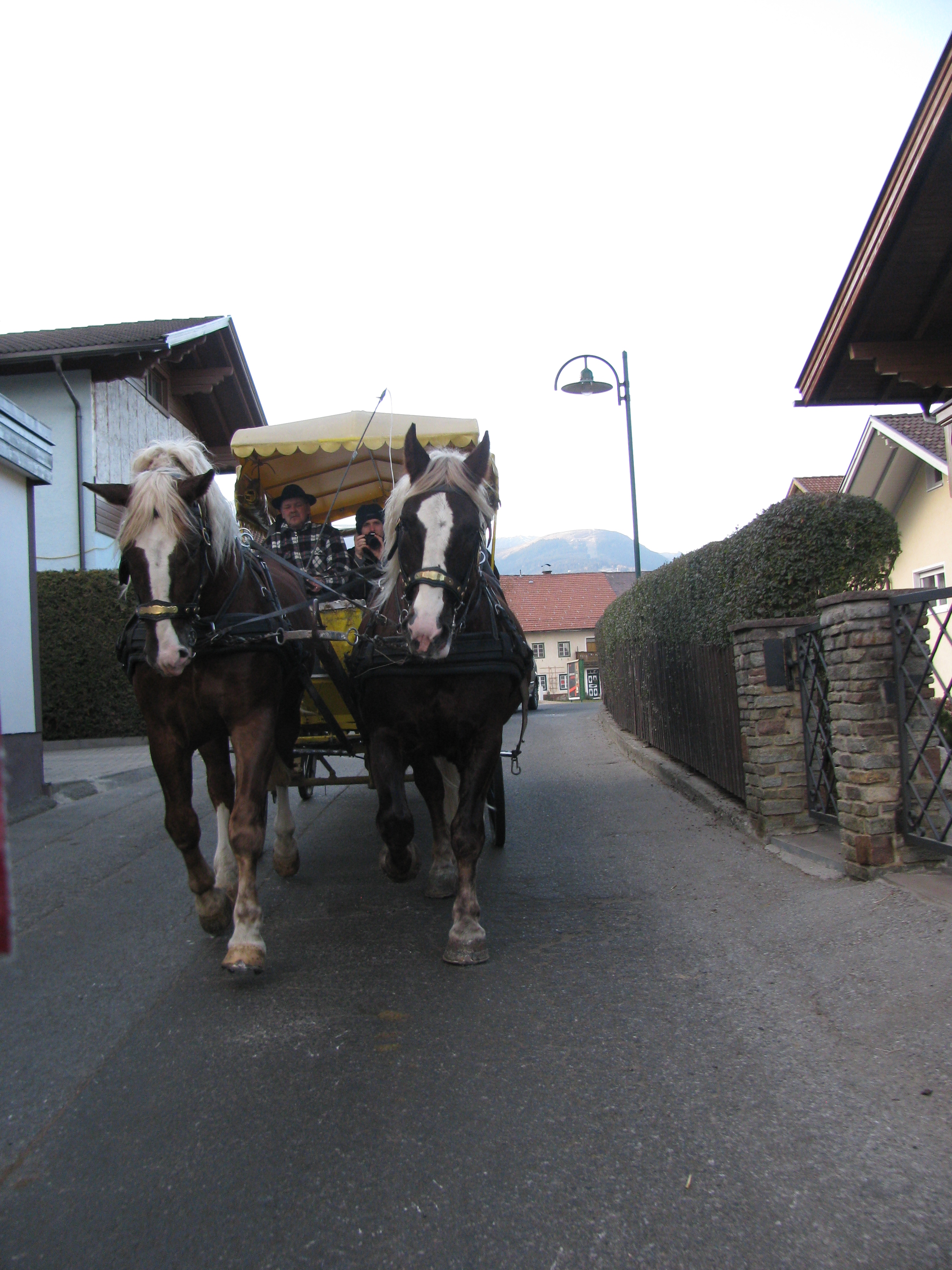
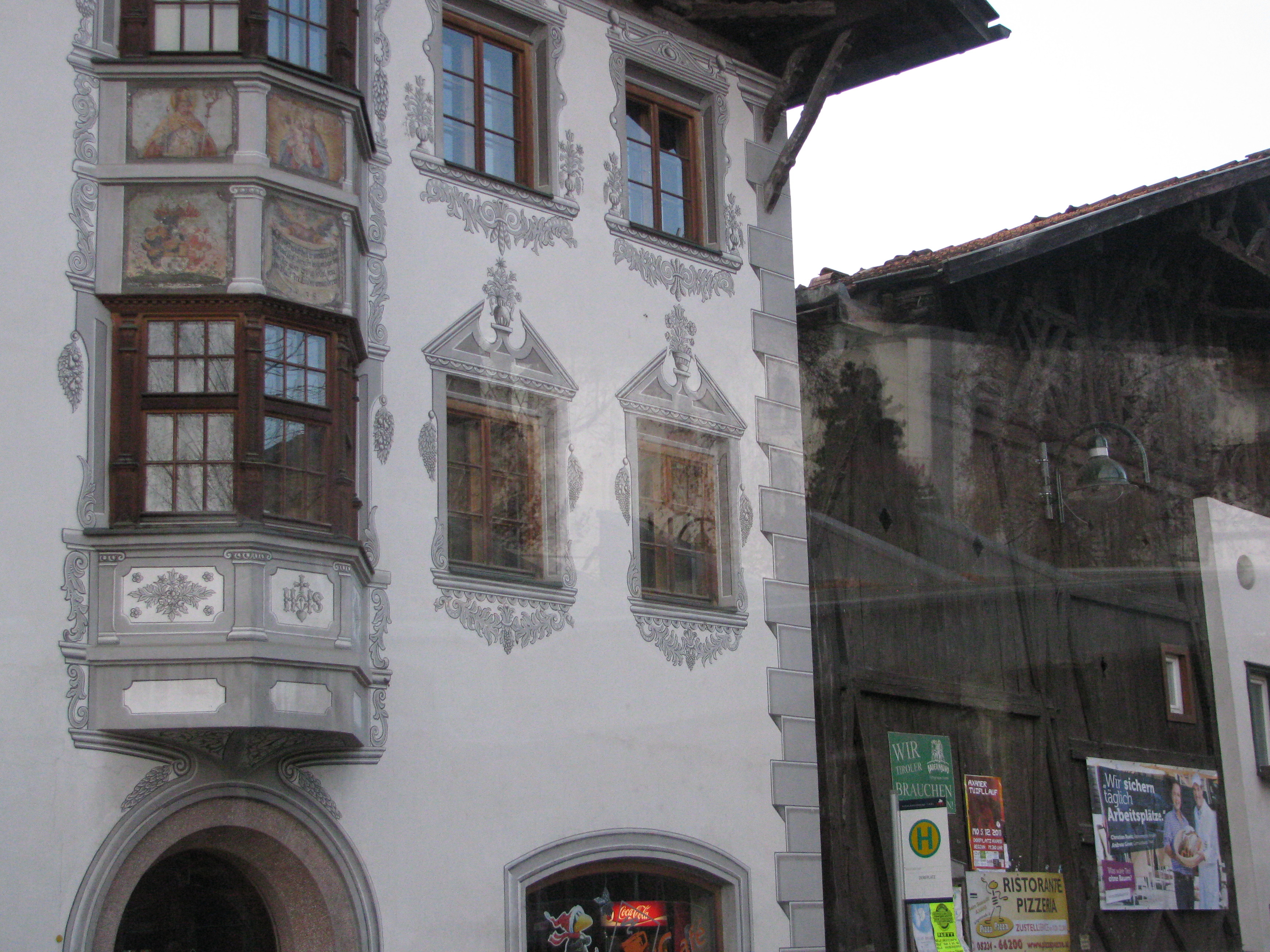
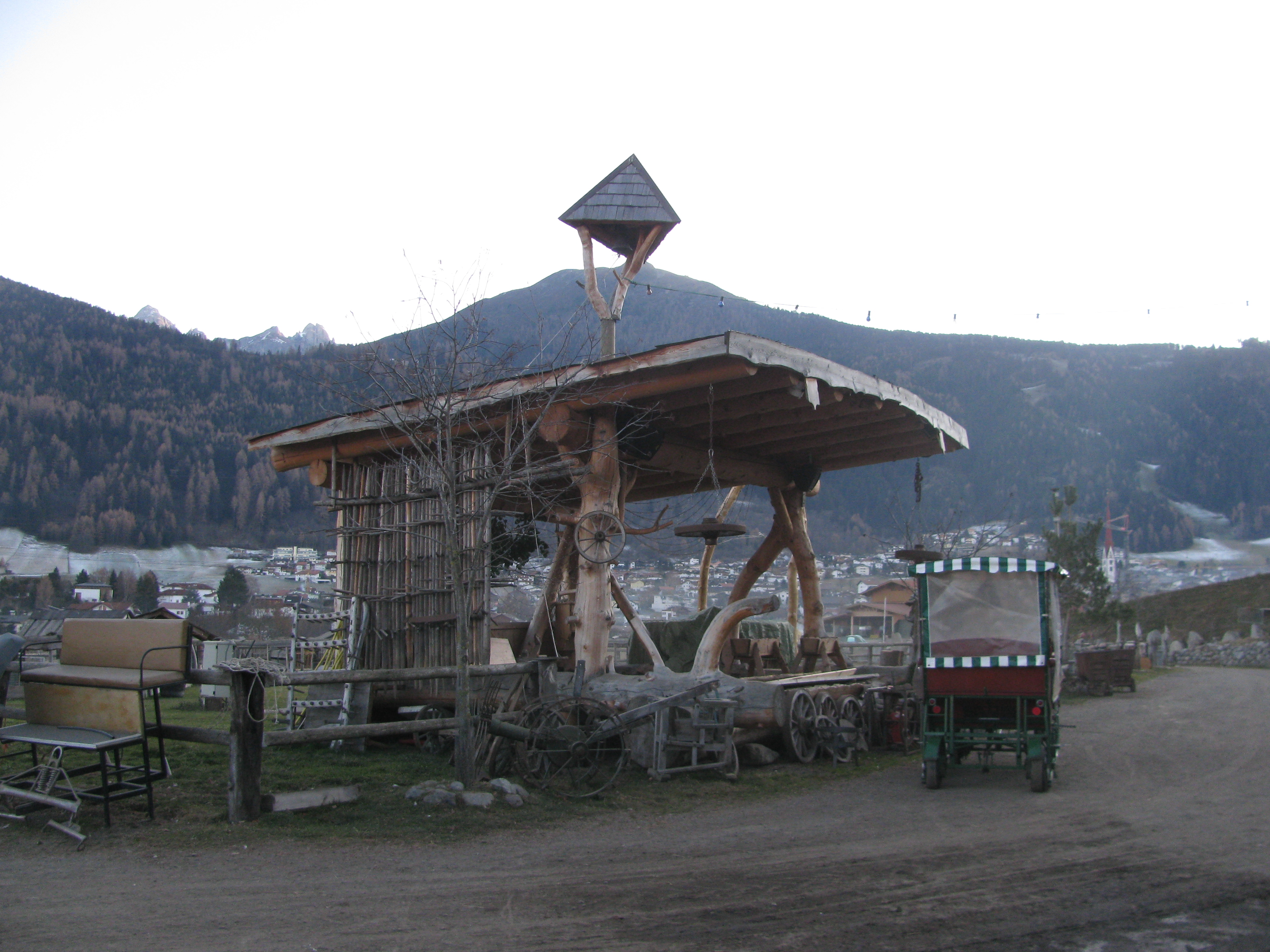
We ditched the bus for an old fashioned carriage ride, complete with horse drawn poop bags, which got to serve the purpose for which they had been made. I began to think about times gone by when horse drawn vehicles predominated the streets. How the streets would have had the sweet sick aroma of horse dung. What a stink it must have been. The carriage ride took us to the Goetzens Church, am amazing edifice to the devotion of the Austrians to the catholic faith.
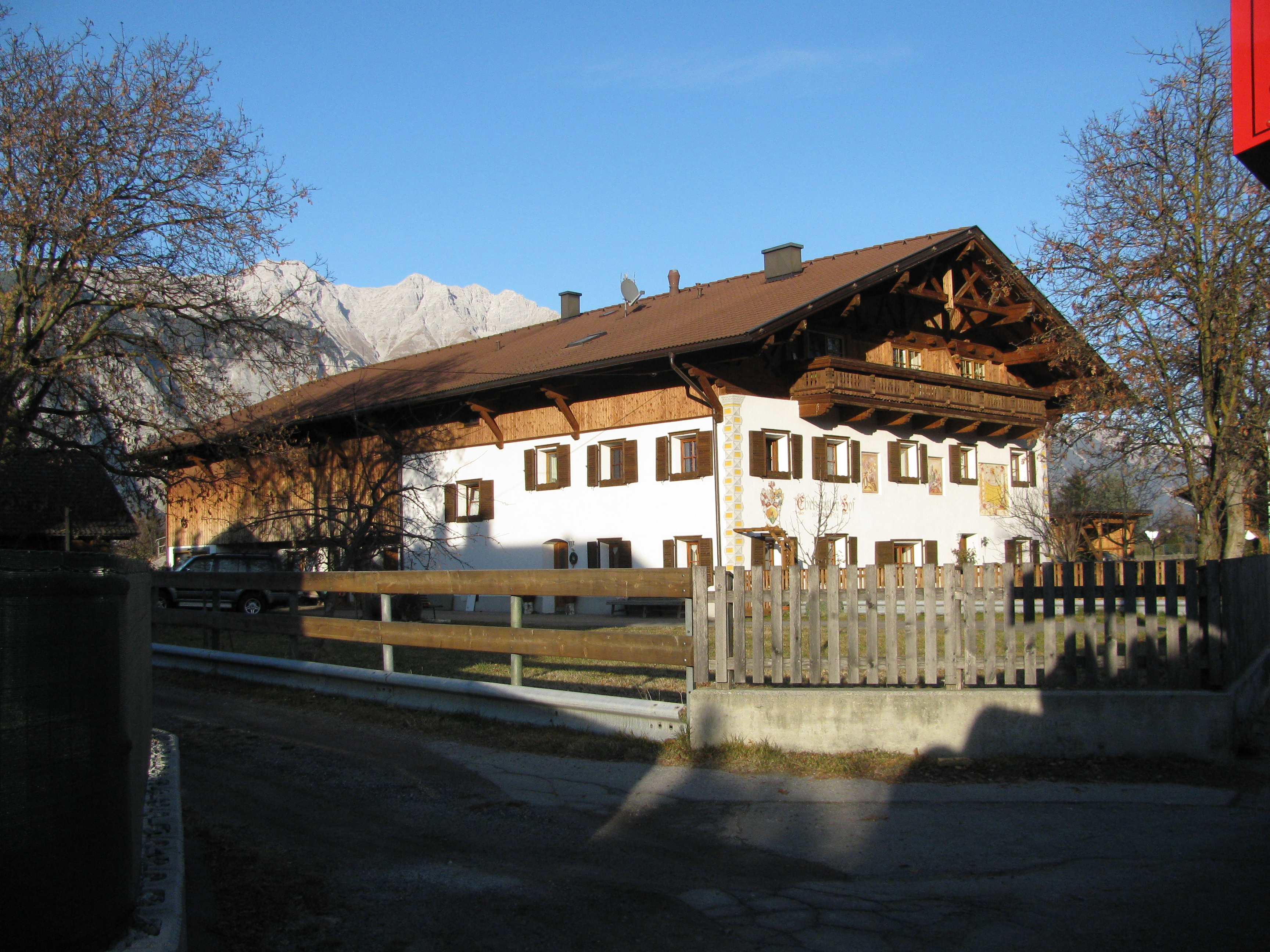
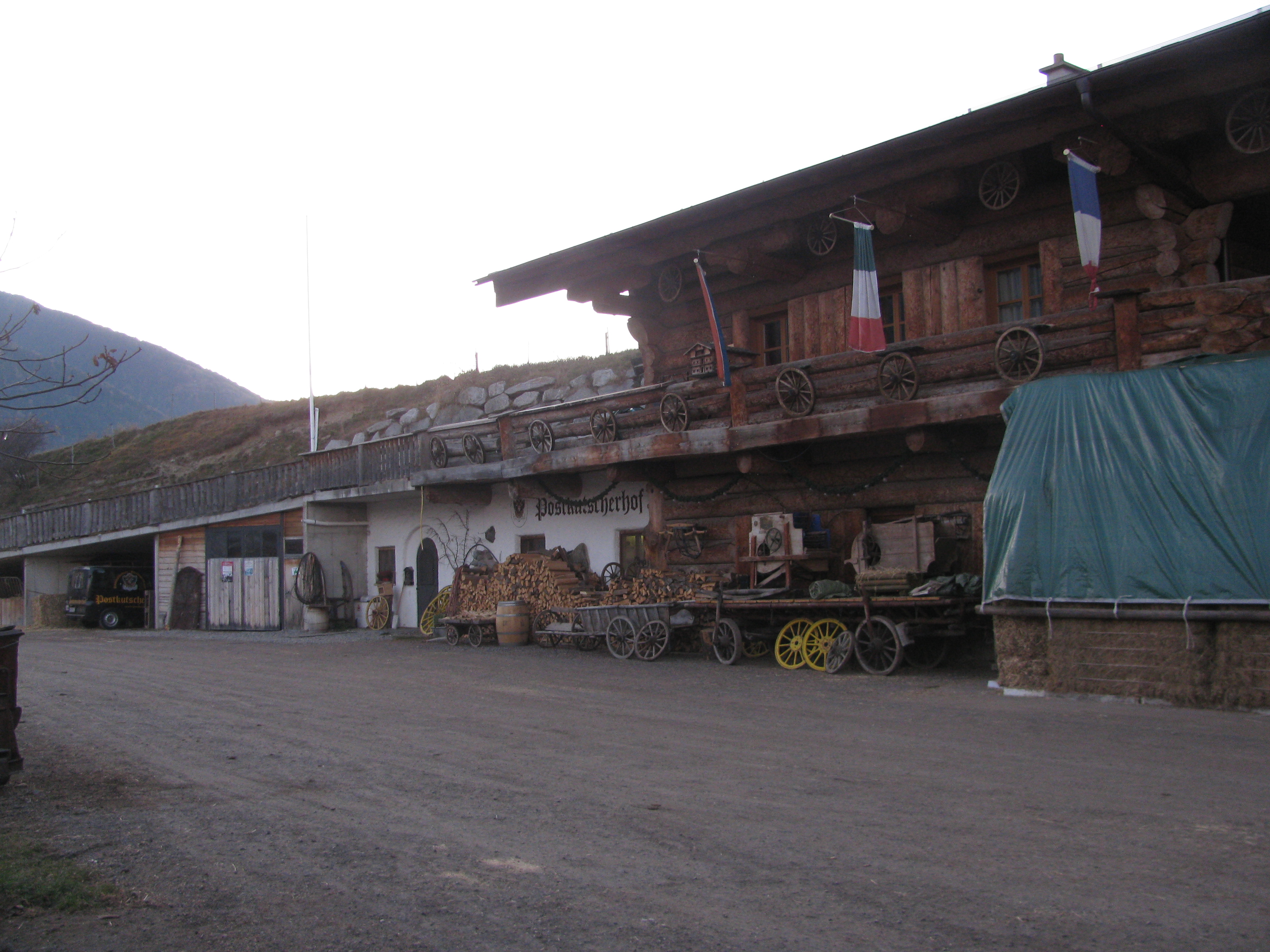


'Fritz' (- was that really his name: how appropriate!) then entertained the passengers at his farm stud, where we saw beautiful throughbreds, tasted snapps and listened to Fritz yodelling and entertaining us. It was a shame that the snow did not allow for a sled ride, as what would normally be found in Austria in wintertime, but I quickly learnt the Austrian countryside is just as delightful with a green carpet.  Except for those darn power lines, and the odd Austrian getting in the way of a good landscape shot!!!
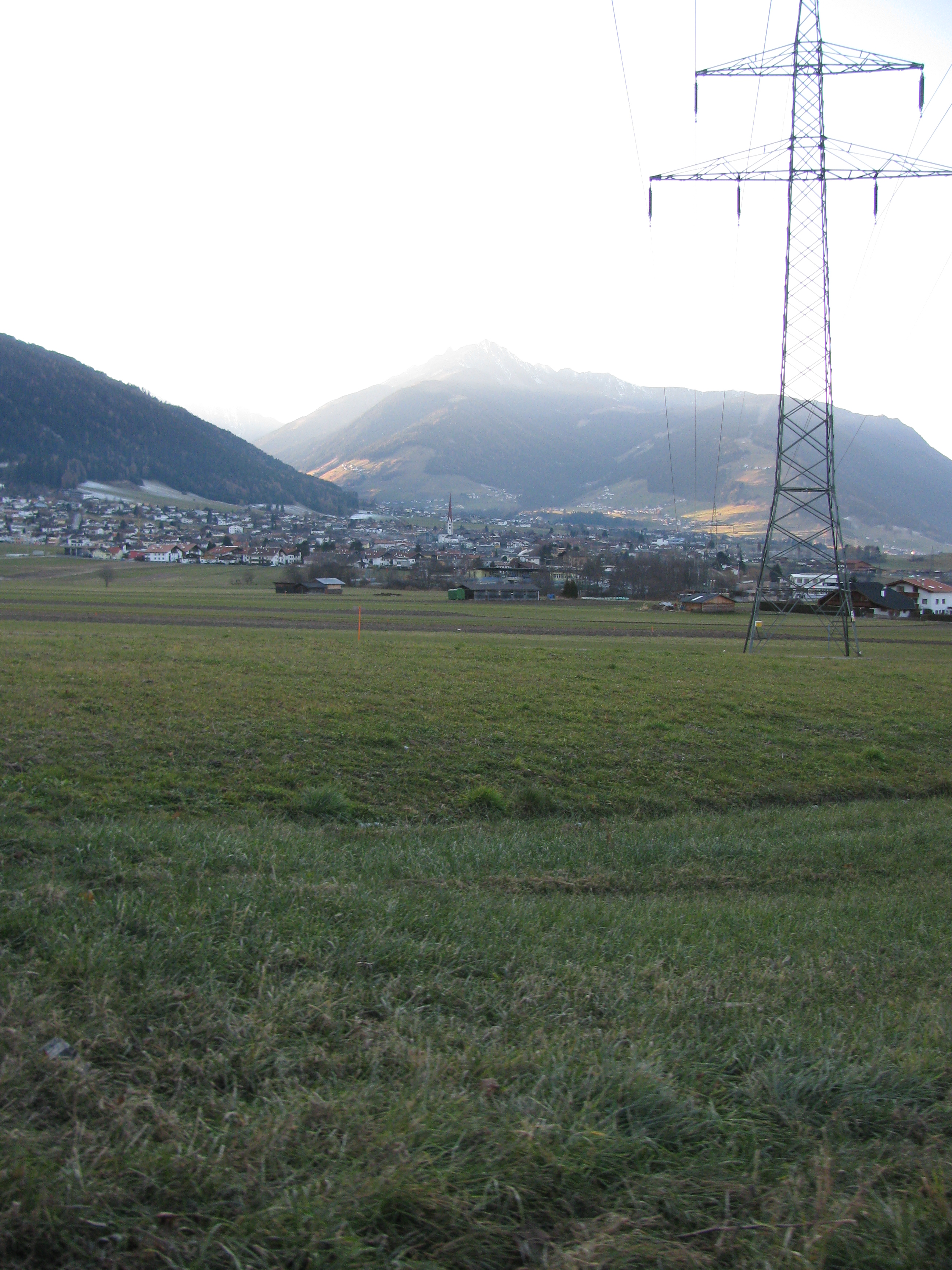

Back to Innsbruck, we scoured the Xmas markets whilst the young men of the group checked out the casino, part of our hotel complex. The more refined guests partook of dinner at the Sandwirt on the River Inn.  Something I won’t be pondering on is how they felt after the casino visit……

Monday, August 6, 2012

Part 7 - Travel Diary Munich to Salzburg 29th November, 2012


The weather was foggy, and frosty but cleared up to a wonderfully sunny winter day with a temperature of about 8 degrees. Although sitting in the peak hour Munich traffic, it seemed almost hotter than this. Traffic is extremely chaotic for a German city, given Germany's penchant for efficiency and orderliness! We drove past Lake Chiensee and later Lake Hohnsee - where one will find another of Mad King Ludwig's Castle ( we did not see it - but apparently it is neither finished nor as stunning as Lindenhof) and on to the infamous Berchtesgarden turnoff or Ausfart ( Ausgang )
First glimpse of glorious Austria was the Tirolachen / Osterrich ( which means East Kingdom) Border Stop which provided a rather disappointing backdrop consisting of heavy industry such as Ikea, Scania, and Bauhaus. However, the view from the roadhouse stop was surrounded by of course, Mountainous alps, not yet draped in snow :-(

I purchased rather aptly, a scarf featuring edelweiss and it has proved to be quite an asset. Made of silk, it keeps my neck surprisingly warm without the bulk of wool, and is a little decorative to boot. Heidi decided to take a few artistic shots of the frost, on the ground, as it was the closest thing we had got to snow, thus far.


Driving in to Salzburg, I snapped a shot looking up to the medieval fortress that dominants the city hills.


After we settled in to Castellani hotel room, resplendent with Juliet balcony, we had a walking tour of Salzburg, viewing a variety of sites, where Sound of Music was filmed.  Including the churchyard where the Von trapp family hid, (enhanced by Hollywood) and the chapel dating back to year 1000 A.D., the wall along which the children danced with Maria, and the bridge where they crossed the river in their clothes made from curtain fabric.

Shopping:  There was not much to buy here, and things were expensive. It cost me the equivalent of $5.00 AUD to send two postcards to Australia! The only thing that was cheap was Hot chocolate, made with real chocolate, so thick, it was as if it was melted chocolate. Demmel is the place to go near the old city square, for the best cakes/chocolate ever. Downstairs is a gourmet chocolate shop, and upstairs is a delightful cafe where you will be in awe of the range of delicacies to tempt you. If you are there at Christmas, remember to say "Gris godt" in the shops. A southern German/Austrian/Swiss greeting popular in this parts, meaning Merry Christmas... and don't forget to get your Mozart chocolate balls. Our very lovely guide, from Insight Vacations gave us each a Mozart chocolate when we returned to the bus.

Our afternoon was to be at our leisure, and I doubting that I could afford to buy anything in Austria, opted to see some more sites on the Sound of Music tour before our intimate dinner with an  Austrian family on their farm. The full Austrian experience was about to commence! 


The lake and Van Trap Mansion in Salzburg
If you are a fan of The Sound of Music, you  must visit Salzburg. The places ooozes Austrian culture in a way I have not seen elsewhere. For years Salzburg was its own city, not attached to an empire, and later became the centre of the enormous Austro-Hungarian Empire prior to WWI. In the War, Austria lost everything, including its port, so the navy was stood down and the reputation of the once great power in ruins. It was in this wake, the Von Trapp family ( the real ones) travelled to America to seek their fortune. So the sound of music story is a real one, albeit embellished to some degree. We saw the beautiful house where the family purportedly lived, but it was in fact, a much more modest house, later occupied by the Brotherhood of the Holy Blood, and now destined to become a B&B. 
The Gazebo used in the Movie, The Sound of Music.
We walked and posed for photos in front of the orginal gazebo where Leisl sang, "I am sixteen going on seventeen" and saw the lane where Julie Andrews sang "I have confidence." The buildings are quite magical and our guide, so sweet and full of Austrian humility. The irony she told us, was that only now was the Sound of Music becoming known in Salzburg, as it was now being sung in German. Austrians, like Germans, only watched overdubbed films, not sub-titled cinema. 


And to top off an amazingly excellent day we were invited to Borg's farm, where we saw the usual farm animals, and feasted on a three course meal of home made cheeses flavoured with egg/paprika/pork juice and potato ( all made on the farm), Roast Pork and strudel all whilst seated in a Austrian style ski hut. The authentic Austrian experience - can I join the Austrian culture please? ah.. the way for females to Austrian community is through the 3 k's: "Krist, Kinder and Kooking"... Children, church and cooking/cleaning.... Something for would be Austrian's/new immigrants  to ponder about.


Map
Visit Book Blogs

Friday, May 11, 2012

Birthday lunch on the Mountain


The week of celebrations continue as I enter my sixth decade.... 


Heading up to Mt Tamborine, for a beautiful leisurely day out, it seems we weren't alone. Hoards of old and vintage car enthusiasts joined us. Unperturbed, we sought out a little Dutch establishment to satiate our hungry appetites.
 The extent to which I am drawn to Scandinavian and Dutch culture, appears to suggest that I have Dutch blood / genes... but I have not. Well, none that I know of, at any rate!!! There is mystery grandfathers in my family.....

In fact generically, I could say it is the Hanseatic league's members states, are the culture that resonates with me. So I felt right at home here for lunch.


 The Dutch clog Barn includes a souvenir shop with clog making demostrations on weekends, sales of Dutch licorice and lollies, and a delightfully simple and nutritious Cafe menu, peppered with well known delicacies such as Kaffe waffles, ( Dutch style) and Poffertjes. I chose a Dutch pea soup with adornments of Cheese and Pumpernickel. Had to had something with cheese, as it was a Dutch cafe!! The rather tall waitress had all the hallmarks of a average height Dutch lady, so the cafe had an element of authenticity, embellished with the Dutch clogs, plates and knick knacks on the walls.
I had to wait quite a while for our meals, as did the other customers, but it really wasn't a problem for me. I was in no hurry and quite content to soak up the atmosphere. Prices were reasonable, with desserts around $6, mains around $10.00.Drinks, averagely priced but deliciously decadent, as you can see by the Iced chocolate.

Despite the wait, I can recommend the Dutch cafe. Just take your time!! Be relaxed and ponder about things that make you feel like you are in, a little bit of Holland....


Saturday, March 10, 2012

Oberammagau - Oh my God!!

Statue of Ludwig 1 - the great builder of Munich architecture


Map


Linderhof Palace


Munichers have a strong sense of nationalistic pride and a history buff like me can feel a haunting sadness in this city. Is it just me, or do I detect covert elements of of national socialist sentiments still present in  this very modern fast-paced workaholic environment?  The history of the city with its Greco-roman architecture – the legacy of King Ludwig’s father Maximilian. The son, Ludwig 1 had to abdicate because of Lola Montez 
Footnote from Wiki: Eliza Rosanna Gilbert, Countess of Landsfeld (17 February 1821 – 17 January 1861), better known by the stage name Lola Montez, was an Irish dancer and actress who became famous as a "Spanish dancer", courtesan and mistress of King Ludwig I of Bavaria, who made her Countess of Landsfeld. She used her influence to institute liberal reforms. At the start of the Revolutions of 1848 in the German states, she was forced to flee. She proceeded to the United States via Switzerland, France and London, returning to her work as an entertainer and lecturer. For a time she visited Australia.
Her alleged affairs included not only a Russian Tzar, and Liszt, but also Australian miners, no less.­­ And Ludwig's son, and successor, Ludwig II, went mad and probably committed suicide... and it is his palace that we visit later today.  But first, The bus drove up Maximillian strasse ( with its designer schiki mikke stores) and then Ludwig Strasse (named after the first Ludwig) and saw the state Library, Ludwigs' church, and the University. Also Michael, the bestest bus driver, stopped briefly outside St Peter’s church where the bones of some Saint were venerated in Gold!!!
Dindl and accompanying scarf = 205 Euro


Traditions in Germany
Instead of speaking of Santa bearing gifts at Xmas time, they might ask, "What will the Christ child (Christkindl) bring you?" Krupesch is the helper who comes knocking at the door. In years gone by, he would ask the children if they had been good during the year, and if so, he would give them a gift, and if not, the children might be rewarded with a whack with Krumpesh’s stick on their behind. This Christmas tradition is also found in Austria, and some young children today, are scared witless, such that they hide under the table. 

Traditions are not forgotten as many women will attend Christmas or special events wearing the Dindl, but as with other national costumes, they are notoriously expensive: A dindl scarf costing 205 Euro but it will last forever!!

Deeply proud, righteously religious, abrupt, hardworking, food with lots of cream are some of the words used to generalize about these people. A sense of superiority pervades their mindset and this is no more apparent than in the  architecture, grandiose buildings reminiscent of Greco-Roman empires. Bavaria has been a separate state for 800 years. This trickles through the Bayern consciousness even now. In Victualmarkt, several group members had been reprimanded severely for touching items on display. The sign, in German, was too verbose to be clearly understood. A central maypole is usually seen here too, but this was taken down, due to rot!!! We saw the remnants sawn through, on our morning stroll the day before. Normally it is painted blue and white, the nationalistic colours of Bavaria. The German eagle watches suspiciously over all in his field of vision.

Allotments are a way of life here, especially for apartment dwellers. Surprisingly for Germany, Frankfurt allotments were rather untidy, but here in Bavaria, the have been maintained to a good standard. The famland around Munchen are clearly postcard picturesque. In efficient German style they are neat and tidy, and green rolling hills are a predominant feature. Swiss style housing can be seen in Bayern, surrounds as well as old barns ( still neat and tidy ) with a tiled roof. The Bayern/ typically swiss cantilever balcony in wood also feature heavily, with whitewashed walls and timber fretwork shutters and timber -framed top storeys.

Food
Germans also love their meat, Leberkast ( Roast lamb on a bun) can be had for as little as 1.50 Euro. Order some Kartoffelsalat and Broet with a kaffee/cappuccino for only 3.90 Euro at the Hofbrauhaus!!!
 
Taverna del sud was the restaurant of choice in Munich, an Italian tavernetta, quite popular with locals. We were accompanied by two of the single ladies on our tour. One lady from Sydney, a corporate secretary, with a hilariously named poodle called Dave and the other lady from Melbourne, a nurse with a son who was an artist. Thin crust pizzas, lasagne and very good House wine ( Red ) was very reasonably priced, at 2.30 Euro and we had attentive service from an Italian waiter, but don’t ask him about his personal reasons for coming to Germancia.   Suddenly he does not know a lot of English!!!  

Footnote: German wines are apparently very good, as they should have had years of practice perfecting their skills and located between Italia and France, they must have picked up some hints!! The word is that the good wines are kept for consumption, and exporting only the wines that are crap…. Something that is also for home consumption and difficult to import ( at least into Australia) is the Lebkuchen, which can only be translated to Gingerbread, but is more akin to Cake than biscuit.   
As previously mentioned, in the Rothenburg**** post, they can keep their Snowballs, yuk yuk….but the Super Dickman ( super meaning large) will be gratefully accepted and purchased at will.


Road to Oberammagau
It is no surprise that dairying is the main industry here, butter, cheese, milk all contributes to the quality of the cakes here….!! Every few kilometres one sees a Romanesque or Baroque church, with the onion dome tower so typically seen in deeply catholic Bavaria!

Oberammagau
Farmland around Munchen consists of rolling green fields, housing thought to be typically Swiss, consisting of White walls and timber framed upper storey, with timber fretwork cantilevered top  storey  verandahs, and painted facades on white walls with shuttered windows. firstly without painted adornments, neat old barns, with tiled roofs. Surrounded by vast tracks of coniferous forests. And all the while, the fantastic  backdrop of Alps, which stretch for 1600 kilometres through France Germany Australia Slovenia and of course Switzerland.  No wonder Hitler had his Eagles nest here, he must have felt like he was on top of the world and wanted to won it all…….­


Oberammagau is our lunch stop and besides the enormous and gob smacking range of painting on the houses, mostly religious in orientation, there is some wonderful shopping to be had here. The town itself is where the very famous Passion Play is held every 10 years. The history of which dates back to a promise the towns people made if the almighty spared their town from the Black death. And to this day, the people keep that promise alive. Hugely popular amongst tourists and pilgrims alike, Oberammagau is a delightful small village set in a picturesque part of the alpine region of Bavaria. 

Ettal Monastery
Inside Ettal

A wonderful extravaganza of Baroque art, the epitome of White and Gold perhaps as with a lot of Catholic churches, a perverse history of sexual abuse of young boys..
Gothic churches were designed to separate the general public from the monks by a central crosspiece (Division of the nave) but in the baroque style the altar is uninhibited and design streamlined.

Wiki tells  us: Ettal Abbey is a Benedictine monastery in the village of Ettal close to Oberammergau and Garmisch-Partenkirchen in Bavaria, Germany. With a community (as of 2005) of more than 50 monks, with another five at Wechselburg, the Abbey is one of the largest Benedictine houses and is a major attraction for visitors.  Also on a less tasteful note:
In early 2010 ten priests at the Ettal Abbey boarding school were accused of sadistic beatings, molestation, or making sexual advances on boys as well as sadism. In March, 2010, authorities raided the monastery as part of a probe into allegations that priests sexually abused children there [CNN: [1]. By an Apostolic Visitation and an independent investigation these allegations have been surveyed and consequences have been drafted. The major part of abuses have taken place in the late 60s, the 70s and the early 80s.

Linderhof Palace and King
Mad King Ludwig, himself

Ludwig

 Mad King Ludwigs reign began when his father died prematurely and so he became King at an early age. Known for his eccentricity, he built 3 fairy tale castles, the most notorious being Neuschswanstein, a magnet for tourists. However today we were to visit the smaller palance of Linderhof, where Ludwig was to spend the last 10 years of his life, in seclusion, prior to being admitted to a psychiatric facility.

Really he was an utter weirdo, but handsome and turned quite strange around ugly people, to the point where he made ugly servants wear masks! He did not finish his study and had no friends his age. The deaths of his tutor and Father at roughly the same time, affected him greatly and he would undertake no diplomatic duties much to the chagrin of his advisers. Homosexual and completely anti – social, his palace at Linderhof only has one bedroom and is the only palace he was to complete in his short and tortured existence.

Finally he was declared insane and was committed to an asylum outside Munich, where he was given to take long walks with his Doctor late at night and one night they were both found drowned in the lake, despite the fact that he was a good swimmer. The exact circumstances remain unknown to this day. It was commonly thought to be a joint suicide.  Politically, this coincided with the combination of Prussia with Bavaria, which ended Bayern isolation as a separate state and opened the door to Bismarck's German empire and the first German parliament in Frankfurt!!


The chapel at Linderhof

Gardens and fountains at Linderhof
 Here is what my an eleven year old wrote about today. I was so impressed by details I have missed that I wrote it here:
Then we were going up into the mountains today. We were going to a king’s palace. His name: King Ludwig. He became king at a young age of 18 years! He was very good at sport and lots of people knew him. But when he became king he became very sensitive and depressed. People said that he was an odd fellow and didn’t like to be seen so that was a problem of being king. He was very handsome but he wasn’t a very nice king. He never entertained only for himself and sometimes in the middle of the night he would wake up and say for example: I want to go sledding tonight. So all of his servants would have to get up and go sledding with him because that was his orders. He made a few castles, but we were going to the smallest one. He made it very hard for people in the public to find him so he put it up in the mountains so it was very hard to find. We walked up a long walk way but it was worth it. The castle only had 12 rooms. We first went into the living room which is the starting room. Before we went up the stairs we went through a second room which had 3 million dollar vases. One huge from Paris and 2 smaller ones from China, so if you broke one you would probably be broke. We went up to the first room. It had a peacock which was his favourite animal and instead of using a flag to symbolise that he was home he would put the peacock out the front which was different. The second room didn’t really have a name but it had a large wooden chair at the front and a velvet robe at the top. The next room we went into was his bedroom. He had a massive bed the colour of blue (which was his favourite colour) and 2 small vases from Paris. The room next to his bedroom was the dinner room. There was a lovely wooden trap door and there was a table that went with it and there were pulleys attached to it so because he never wanted anyone to see him they would pull the trap door down to put the food on and then when he wanted dinner they would pull it up. The next room was called “The room of mirrors” They had 2 mirrors reflecting off each other so it looked like the room went on forever. There was a bid couch which was blue and he would sit there and read his books. Then we walked out of the room and down some secret stairs. Then later on they said that the public was sick of him being king so they tried 2 times but he had two many guards so he was protected very well. One day he went for a walk with his doctor (they went on frequent walks) and he never returned. Later they found him and his doctor drowned in Lake Chiensee. The public was very surprised because Ludwig was a very good swimmer. Some people said that he slipped and fell and his doctor came in too. They also weighed his brain but it was very light. After Ludwig died there was no one to run the kingdom and he never married or had children Ludwig’s Grand farther took over and when he died it was a long time before a new king was chosen.


Visit Book Blogs

Sunday, March 4, 2012

Day 6 - Munich - the city and Xmas markets


  • MapVisit Book Blogs
I think this is the first photo is the Museum of Folk art... but I neglected to label it, so am not sure. We are headed for the Marienplatz, to see the Glockenspiel - pictured here.


The heyday of King Ludwig's building program reliving the dreams of Ancient Greece at Konigsplatz - Glypotek.


Hotel Hilton Munich Park
Still feeling a bit of neck stiffness from the night flight from Singapore, and sitting in the bus for hours, I made a b-line for the Spa and Fitness centre, once I arrived at Hilton Munich Park, where I had a 15 minute massage with Antonia, for 15 euro. Sublime surroundings and the expert masseuse ensured I felt totally relaxed when time was up. Returning to the room, we reluctantly paid 8euros for 1  hour of internet time....Hilton does not offer free internet, at least not in Germany.

Come breakfast time, I had nothing to complain about. A magnificent feast awaited us: and we thought the hotel in Frankfurt was delicious. There were fresh pancakes, here, an incredible array of cheese and smoked salmon, hot dishes and pretzels and buns to die for... I was really exhausted just trying it all. I wanted to, but could not bring myself to try the white sausage wurst - it just looked wrong! Hot or cold.
Breakfast pancakes

Orientation tour of Munich 
Munich has 1.3 million people and is at 1800 feet or 540 metres. We saw the Chinese pagoda, and English garden from the bus,  Bavarian Museum of Folk art... How I wished I could have gone inside...The Haus der Kunst (Modern Art) which Hitler had used, and the Bavarian Chancellery. Then along Ludwigstrasse, we passed the Bavarian state library, Ludwigs church, the University and the Triumphal Arch which commemorates the Bavarian armies fighting against Napoleon during 1814-15. The irony is that it was at the Triumphal arch that Hitler was nearly assassinated in the 1920's 'Push'.


Ludwig statue near entrance to Marineplatz at Opera house


Propylean, Munich

We also passed the Music academy which was once the headquarters of the Nazi party. Munich housed more than 40 buildings  connected with the Nazis.

We also passed the eternal flame  to remember all those who suffered from fascism. The Hall of the General and the statue of Ludwig 1, on horseback, the instigator of all this massive building program, and finally stopping at the Opera House, next to the Residenz ( former home of the rulers of Bavaria, the Wittlesbachs. The Wittelsbachs ruled Bavaria for 900 years.

Munich- Ludwig strasse


On our way to Marienplatz


2.50 - 3 Euro Decorations
Our walking tour of the Marienplatz, (Main square) in Central Munich, with its Golden statue of Mary and the fabulous "New Town Hall" only finished in the 1920's. It was at this time that Hitler built the Haus der Kunst (Modern Art gallery) which was as a venue for all the art the Nazis stole from the occupied countries. Munich was after all, the centre of action for the National Socialists. A large Weinactsmarkt predominated in the square with decorations like these:


Marionplatz

Marienplatz with view to Church
 
 The glockenspiel was a crowd pleaser and we all watched the display at 11 o'clock. The top figures represent a tournametn held during the wedding of Duke William V and Duchess Renate Lorraine in 1586. 7 Bavarian knights in the blue and white oclours of Bavaria fight Polish knights in red and white. The bottom tier shows the Cooper's dance. ( barrel makers). Later we continued on to St Peters' and the Viktaulienmarkt. ( Food market selling delicious Hinbaer from Italiensk, and fresh Christmas decorations.)  1 Euro for  a double sized punnet....yum....

Christkindlmarkt

 We were sorely tempted by the fresh decorations of cinnamon/chestnut/ flowers decorations at the Christkindlmarkt but preferred to spend our time eating torte and Topfen strudel at Rischarf's Bakery. Two cakes and two hot chocolates for 9 Euros... Bargain!!! But there was no plain water, typical of Germany, only mineral water and 50 cents to use the rest rooms is pretty common.So you are warned!
The view from Rischarfs Bakery

What was left of the torte and Topfen strudel after a few minutes.

Rischarfs delicious bakery treats


You can not say that you have been to Munich and not been to the Hofbrauhaus, even if you don't drink beer. While it is a place for beer drinkers, of which I am not one.... the food menu looked rather nice.


Kaffe/Capuccino was 1.70 euro and kartofflesalat 2.70 Euro, but the padlocked beer steins adorning the walls were for local customers only....

Afternoon optional tour through the glorious German countryside, dotted with Churches with little onion domes every few kilometres. The population not only could see the churches easily from their house, but also could reach it within a half and hour. NO excuses not to attend really, here. At least I am sure that is what the local pastor thought!

This really was an incredible day of touring. After the  morning tour, we stopped at the Ettal monastery where I was gobsmacked by the beaty of the church. Before procedding on to Oberammagau and Linderhof... What an amazing day...
The pictures of this area are too beautiful to put here so I will make another entry... they deserve it....

But I will tell you how we spent our evening.....  once again finding ourselves in the....

Christmas Markets
As it was only just 6pm, and the night was still young, dark, very dark, but still young, we decided to venture to the nearby Englischer Garten, where the Xmas Markets was being held.
Avoiding the walk through the darkened park, because H. felt it was unsafe: we took the streets from the Hilton Munich Park, which is set back from the city and in close proximity to Englischer Garten
(English garden)  and ended up in the rather large Christmas market.
For reviews on this hotel see link here: http://www.tripadvisor.com/ShowUserReviews-g187309-d199637-r83287690-Hilton_Park_Munich-Munich_Bavaria.html

The stalls contain typical German Christmas items like Smokers soaps, decorations and trinkets, and typical German Christmas cuisine,like Gingerbread, and a few exotic dishes thrown in. We even managed to find some Pommes Frites, but it wasn't cheap. For 3 Euro 20 we requested a tray of Pommes frites as my youngster recoiled at the Wurst sausages and kebabs on offer. About some confused german english babbling, I was asked if I wanted Gluhwein with that.... Nein, only Pommes Frites danka.... I said... The attendant held up some Pommes Frites and I said "Ja"!!! I then had to pay 9 euro 20 cents, and received a cup of gluhwein and pommes frites.... well I don't really mind the gluhwein but it is the most expensive chips I have ever had.. By now is was after 6 pm and the markets became so busy, it was difficult to move around, so we made our way to the exit where we hoped to find a seat. A German women grabbed my arm and said something angry to me. ( But then, German for the most part, sounds angry anyway!!) When I feebly asked her if she could say it in English, she asked me Where did I get those? ( pointing to the silver plated Pommes frites!!!)  Now I know why they were so expensive, they threw in some free Gluhwein!!!! They are highly sought after!!!!!!

Joking aside, there was a wonderful atmosphere here but the temperature did plummet in the midst of the garten, especially when the wind picked up. The babies did need their little papooses tonight.  Upon returning the empty cup of gluhwein, and collecting my 1 euro deposit.. we strolled back along the side streets where large square roofed manor houses predominated. They looked like terrace houses, and were two storey, but had sloping roofs. I wondered how many had been divided up into apartments, and how few retained their original layout of the likes found in Clara's aristocrat's house in the book, Heidi.

Finding the way back to the hotel was easy as the location was adjacent to a little weir with the Isar river flowing at speed with black looking, very cold water!! Would not want to fall in that....that is something I do not want to ponder about..